
When Mom needs help: why caring for aging parents can split siblings apart
GMA put sibling caregiving stress on the national stage this week. Here is what the research says, why it hits Kootenai County harder, and what helps.
Good Morning America spent this week on a problem a lot of families know too well: what happens when Mom or Dad needs help. On Thursday, GMA's Lori Bergamotto reported on the stress that builds between brothers and sisters when they care for aging parents, especially when one sibling ends up as the main caregiver.
It is a national story with a local edge. Kootenai County is older than Idaho and the country. About 1 in 5 people here, roughly 39,200, are 65 or older. That is 20.8%, compared with 17.7% for Idaho and 18.9% for the U.S., by our count of Census Bureau survey data for 2020 to 2024.
Here is what the research says about why caregiving pulls siblings apart, and what helps.
How many of us are doing this
About 63 million Americans are family caregivers, roughly 1 in 4 adults, according to the 2025 Caregiving in the US report from AARP and the National Alliance for Caregiving. That is up about 45% in a decade. More than 4 in 10 give what the report calls high-intensity care.
In Idaho, the same researchers estimate 28% of adults, about 418,000 people, are family caregivers. A separate AARP report this year put the value of the unpaid care Idahoans give at more than $6 billion a year. (The counts differ a little because the reports define caregiving differently.)
Reason 1: One sibling usually carries it
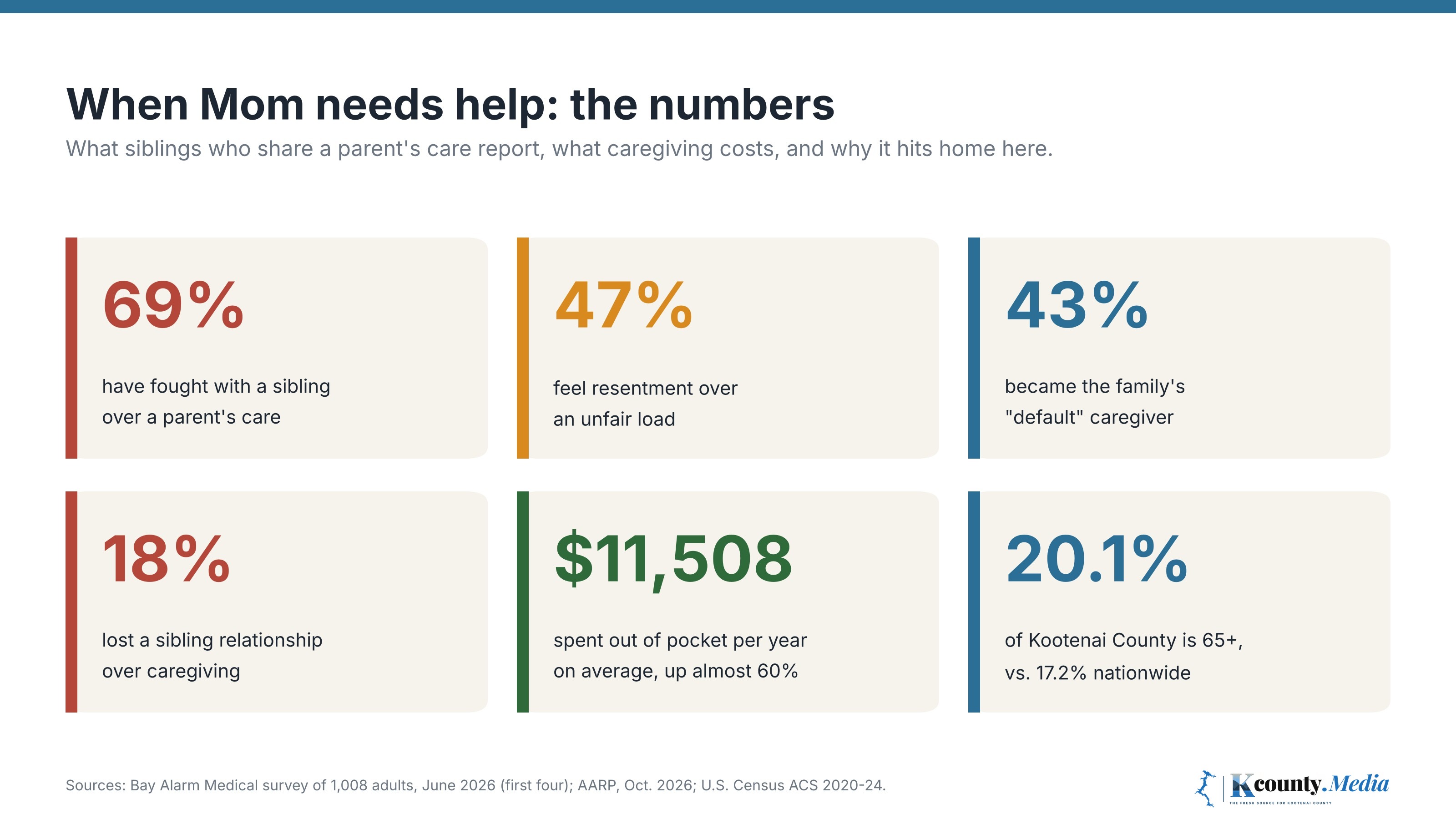
Care is rarely split evenly. In a June 2026 survey by Bay Alarm Medical, a medical alert company, 43% of adult siblings who share care for a parent said they had become the family's default caregiver. On average, that person handled 53% of the parent's care.
Daughters do more of the hands-on work. In the same survey, 46% said a daughter does most of it, compared with 17% who said a son. Academic research has found the same pattern for years: daughters are heavily overrepresented in personal and health care for parents, researchers Karl Pillemer of Cornell and J. Jill Suitor of Purdue wrote in The Gerontologist.
A note on that survey: it covered 1,008 U.S. adults, and the company did not name an outside polling firm. Treat its numbers as a snapshot, not the final word.
Reason 2: Money
Money was the top source of sibling fights in the Bay Alarm survey, named by 36%, ahead of an unequal split of time and effort at 26%.
The bills are real. AARP's 2026 out-of-pocket study, released Oct. 28, found family caregivers spend an average of $11,508 a year of their own money, up almost 60% from 2021. That is about 31% of household income on average, and 76% for caregivers earning under $40,000. Caring for someone with dementia costs more, about $15,846 a year.
When one sibling is paying and another is not, or one is living with Mom and the others wonder about her savings, the math becomes personal fast.
Reason 3: Old family history comes back
Suitor and Pillemer have studied later-life families for decades with funding from the National Institute on Aging. In one study of 450 adult children from 214 families whose mothers needed care, both giving care and believing Mom favored a sibling were tied to more tension between siblings after a mother's major health event. When both were true, the tension was worse.
A related study of 341 adult children found that believing Dad currently favors a child predicted sibling tension even more strongly than believing Mom does. Suitor's research team keeps finding the same thing: siblings are both the biggest source of support and the biggest source of stress during caregiving.
Reason 4: Everyone grieves at a different speed
Gerontologist Sam Cradduck told the Aging Untold program that grief, not rivalry, sits under most of these fights. As a parent declines, siblings start grieving at different times, and some slip back into childhood roles. One may be angry while another has already accepted what is happening.
What it costs families
In the Bay Alarm survey, 69% had fought with a sibling over a parent's care, and half of those said the fights now happen in the family group chat. Nearly half, 47%, felt resentment toward a sibling over an unfair load. And 18% said they had lost a sibling relationship over it.
What helps
Experts quoted across this coverage say much the same things:
Talk before the crisis. Ask your parents what they want while they can still tell you, and get everyone the same information.
Split the work by strengths, not fairness on paper. The sibling who lives close may drive to appointments. The one who lives far away can handle the bills, the insurance calls or a weekend of relief.
Bring in a neutral person. A social worker, counselor or care manager can run a family meeting so it doesn't turn into old arguments.
Write it down. Who does what, who pays what, and when you'll check in again.
Help close to home
The Area Agency on Aging of North Idaho serves people 60 and older and their families in Benewah, Bonner, Boundary, Clearwater, Idaho, Kootenai, Latah, Lewis, Nez Perce and Shoshone counties. It is at 402 W. Canfield Ave., Suite 1, in Coeur d'Alene, (208) 667-3179 or toll-free (800) 786-5536, open weekdays. Idaho's area agencies help family caregivers find training, respite care, planning help and support groups.
You can also dial 211 to find caregiving help where you live.
Are you caring for a parent with your brothers and sisters? Tell us what's working and what isn't. We may follow up.
Sources
- Good Morning America: How siblings navigate caregiving for parents (Nov. 5, 2026)
- Good Morning America: Aging parents cope with their children becoming caregivers (Nov. 4, 2026)
- U.S. Census Bureau, American Community Survey 2020-2024, table B01001 (age), via Census Reporter
- AARP and National Alliance for Caregiving: Caregiving in the US 2025
- AARP Idaho: New Idaho caregiving data released, 28% of Idahoans providing care (Oct. 2025)
- AARP Idaho: Family caregiving in Idaho reaches $6 billion annually (Valuing the Invaluable 2026)
- AARP: Family caregivers' out-of-pocket costs jump almost 60% in five years (Oct. 28, 2026)
- Bay Alarm Medical: The Sibling Scorecard survey (June 2026, 1,008 adults)
- Suitor, Gilligan, Johnson, Pillemer: Caregiving, perceptions of maternal favoritism, and tension among siblings (The Gerontologist)
- Gilligan, Suitor, Kim, Pillemer: Differential effects of perceptions of mothers' and fathers' favoritism on sibling tension in adulthood
- Pillemer and Suitor: Who provides care? A prospective study of caregiving among adult siblings (The Gerontologist)
- Purdue Alumnus: Playing favorites (Suitor and Pillemer's research)
- Aging Untold via WSAW: How to handle sibling disagreements over care for an aging parent
- Idaho Department of Health and Welfare: Area I, North Idaho Area Agency on Aging
- Coeur d'Alene Chamber: Area Agency on Aging of North Idaho (five northern counties, 60 and over)