
What Kootenai County's businesses do, what we're missing, and who's opening and closing
Builders, loggers, real estate agents and coffee stands are everywhere. Shoe stores, temp agencies and psychiatrists are scarce. A full look at the county's 6,221 businesses with employees.
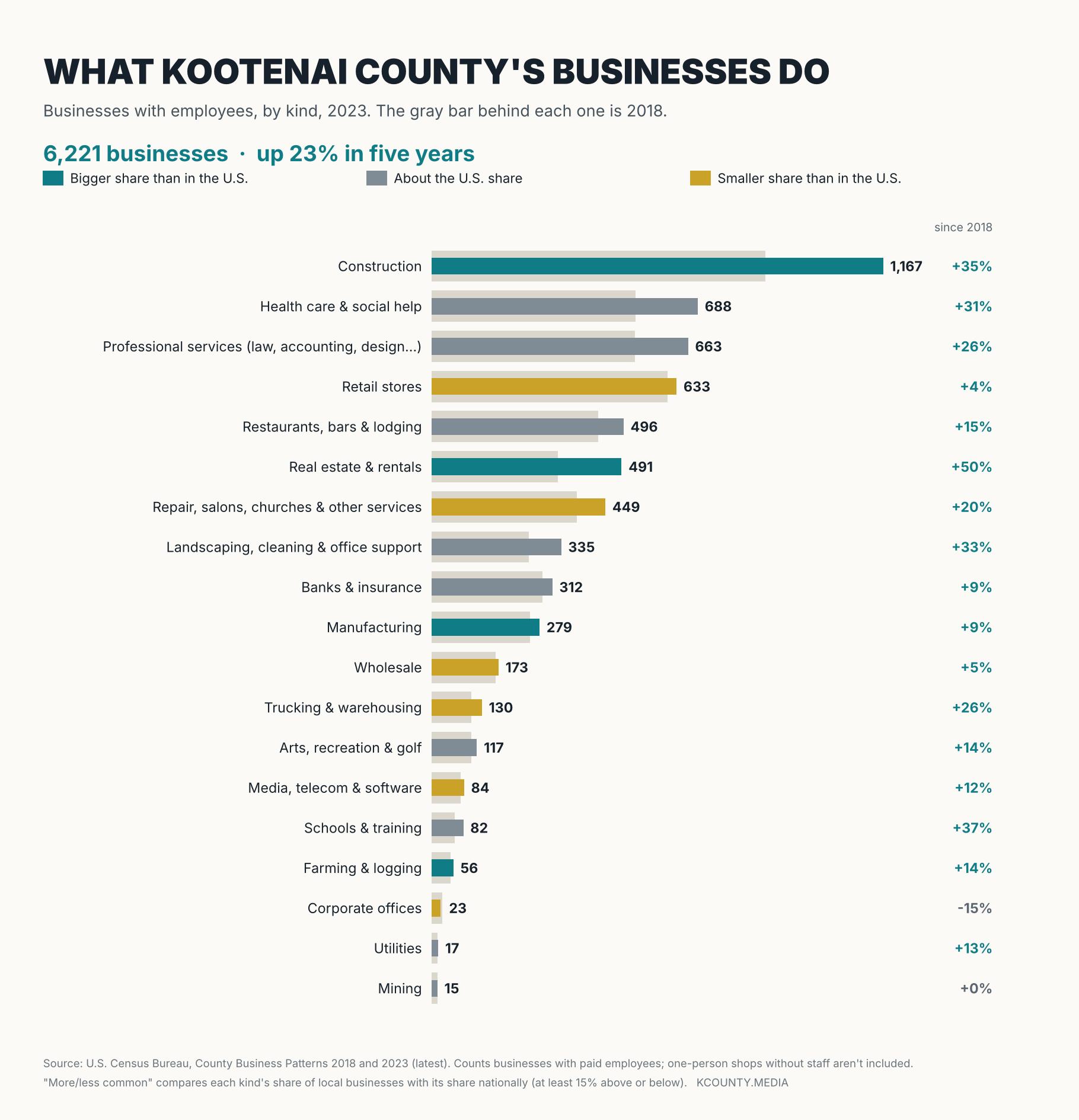
How many businesses does Kootenai County have, and what kind? We pulled the U.S. Census Bureau's business counts for every industry, compared them with the rest of the country, and lined them up with 46 years of openings and closings. Here's the whole landscape.
By the numbers
In 2023, the latest year the Census has counted, Kootenai County had 6,221 businesses with paid employees. That's up 23% from 5,071 in 2018. Those businesses employed 64,571 people, up from 54,852.
The county's population grew too, from 171,362 at the 2020 census to an estimated 188,323 in 2024. But businesses grew faster. For every 1,000 residents, the county has about 34 businesses with employees. The national rate is 25.
The biggest groups:
Construction, 1,167 businesses, up 35% since 2018
Health care and social help, 688, up 31%
Professional services such as lawyers, accountants and designers, 663, up 26%
Retail stores, 633, up 4%
Restaurants, bars and lodging, 496, up 15%
Real estate and rentals, 491, up 50%
Repair shops, salons, churches and other services, 449, up 20%
One kind of business stands out above all others. Offices of real estate agents and brokers are the single most common business here: 247 of them, up from 139 in 2018.
What we're known for
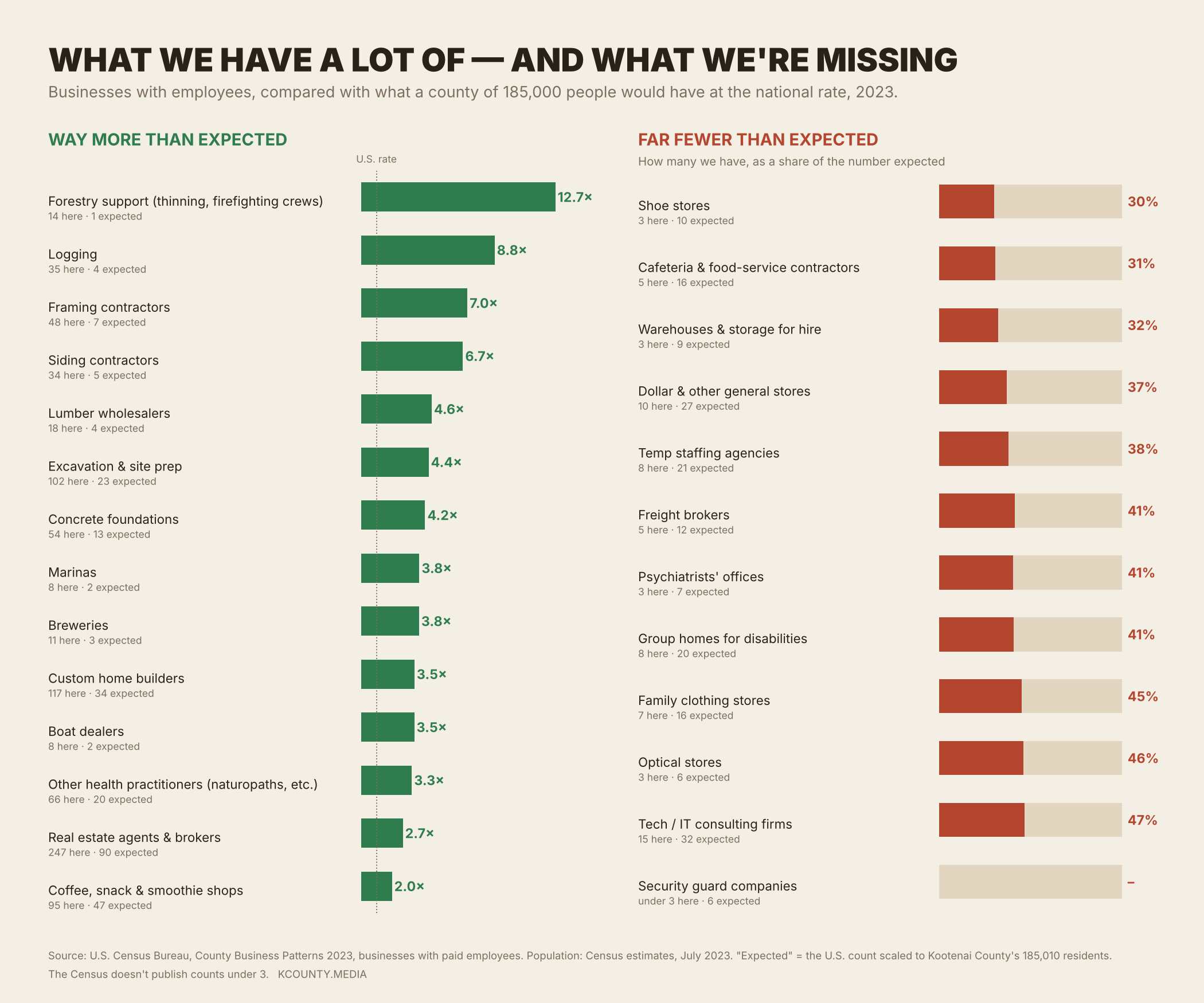
Compared with a typical U.S. county our size, Kootenai County is a builders' and woods county:
Framing contractors: 48 here, about 7 times the national rate
Siding contractors: 34, nearly 7 times
Excavation and site prep: 102, more than 4 times
Concrete foundation contractors: 54, more than 4 times
Custom home builders: 117, about 3.5 times
Logging companies: 35, nearly 9 times
Forestry support crews, which do thinning, replanting and fire work: 14, nearly 13 times
The lake shows up too. There are 3.5 to 4 times as many marinas and boat dealers as you'd expect, and about 4 times as many breweries. Coffee, snack and smoothie shops come in at twice the national rate: 95 of them with employees, which fits what we found when we mapped the county's drive-thru coffee stands.
Health practitioners outside of doctors and dentists, a group that includes naturopaths, dietitians and similar offices, run at more than 3 times the national rate. That lines up with an older population. About 21% of residents are 65 or older, compared with 18% nationally.
What we're missing
Some kinds of businesses are far scarcer here than in a typical county our size:
Shoe stores: 3, where about 10 would be typical
Family clothing stores: 7, where about 16 would be typical
Dollar and other general stores: 10, where about 27 would be typical
Temp staffing agencies: 8, where about 21 would be typical
Freight brokers: 5, where about 12 would be typical
Warehouses that store goods for hire: 3, where about 9 would be typical
Tech and IT consulting firms: 15, where about 32 would be typical
Psychiatrists' offices: 3, where about 7 would be typical
Group homes for people with intellectual and developmental disabilities: 8, where about 20 would be typical
Security guard companies: fewer than 3, where about 6 would be typical
Why the gaps? The data can't answer that by itself, but some likely reasons stand out. Spokane is next door, and many regional companies that serve both sides of the state line, such as staffing agencies, freight brokers, security firms and tech consultancies, can base themselves there. Shoes and clothing are what Americans increasingly buy online or at big-box stores, which Census counts in other categories.
The mental health gap is well documented. All of Idaho is federally designated as a shortage area for mental health providers. When the Coeur d'Alene Press looked into it this summer, it found Idaho averages one mental health provider for every 399 residents, 20% worse than the national average. The group-home gap may also reflect how Idaho funds and licenses that care, but we haven't confirmed that yet.
The few that dominate
In some industries, a handful of businesses do almost all the work. The Census counts show:
Sawmills: 3 businesses, about 440 jobs
Home centers, the big-box home improvement stores: 4, about 480 jobs
Ready-mix concrete plants: 5, about 310 jobs
Diagnostic imaging centers: 3, about 240 jobs
Couriers and express delivery: 4, about 230 jobs
What do those have in common? They're expensive to start. A sawmill needs a log supply, land zoned for heavy industry and millions in equipment. A ready-mix plant needs gravel, trucks and permits. Imaging centers need costly scanners and licensing. Home centers and couriers run on national chains' buying power and networks. That's the "secret": it isn't easy for anyone else to follow, because the barrier to getting in is the business itself. Census job counts for very small groups include some built-in rounding to protect privacy, so these job numbers are approximate.
Openings and closings
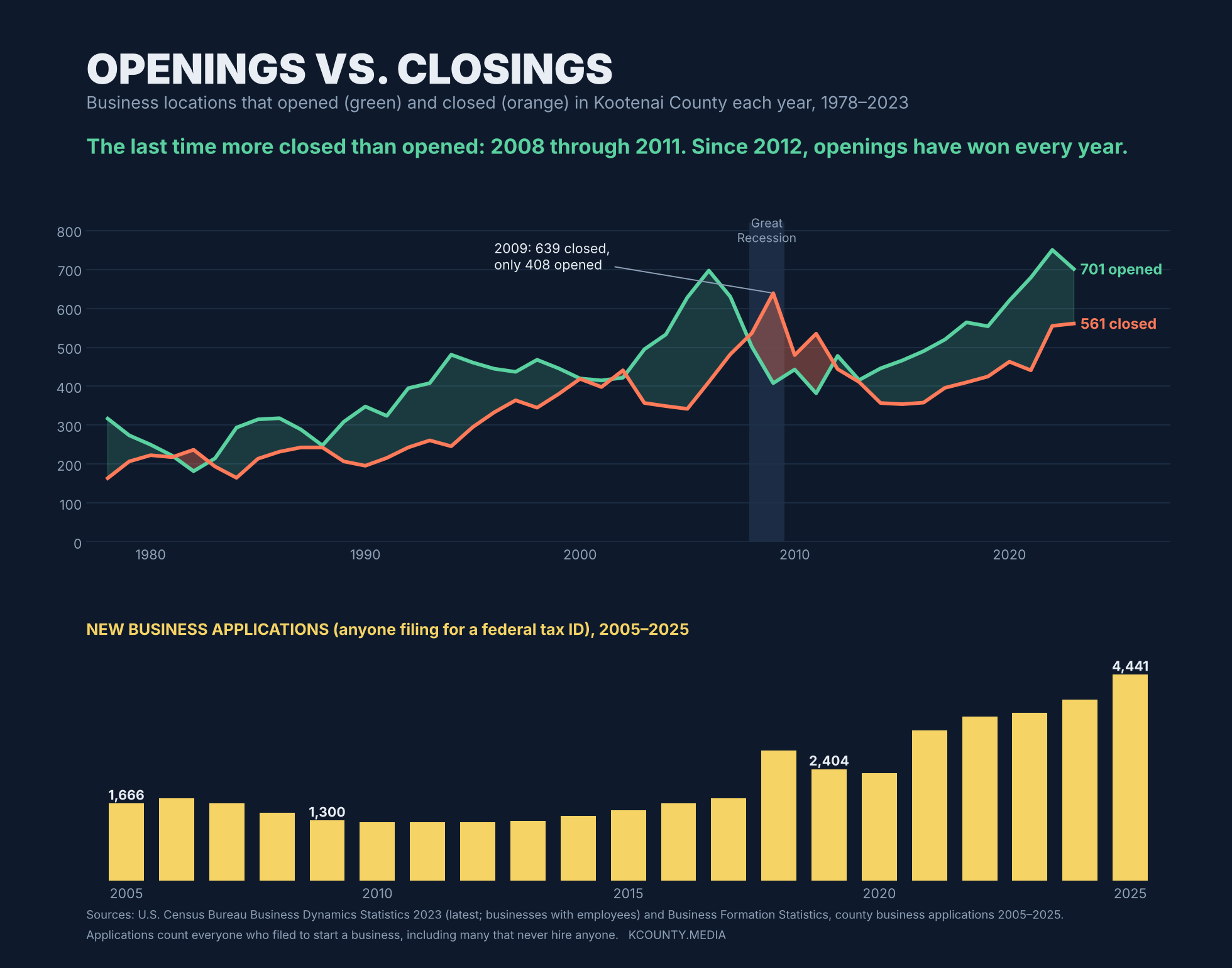
Businesses open and close here all the time. In 2023, 701 business locations with employees opened and 561 closed. That's more turnover than the nation: in a typical year, a bigger share of Kootenai County's businesses are brand new, and a bigger share shut down.
The rough stretch was 2008 through 2011, when more businesses closed than opened every year. The worst was 2009: 639 closed and only 408 opened. Since 2012, openings have beaten closings every year.
New business filings are at their highest since at least 2005, when the Census series begins. In 2025, people in Kootenai County filed 4,441 applications to start a business, the most in at least 20 years and up 85% from 2019. Nationally, filings rose about 62% over the same stretch. Many of those filings are one-person businesses that never hire anyone, so they won't all show up in the counts above.
Busy and cooling in 2023
The Census breaks down 2023 openings and closings by industry. A few stand out:
Construction: 165 opened, 137 closed
Professional services: 87 opened, 50 closed
Health care: 79 opened, 42 closed
Restaurants, bars and lodging: 58 opened, 33 closed
Retail: 42 opened, 46 closed
Real estate: 43 opened, 66 closed
Real estate and retail had more closings than openings, and so did banks and insurance, manufacturing, wholesale and media. For real estate, that's a turn: from 2018 to 2023 it grew faster than any other group.
How we did this
Business counts come from the Census Bureau's County Business Patterns for 2018 and 2023, the latest available, which count businesses with at least one paid employee. They don't include the many one-person businesses with no staff. Openings and closings come from the Census Bureau's Business Dynamics Statistics, which run through 2023, and new business applications from its Business Formation Statistics, which run through 2025. "Expected" counts take the national number for each kind of business and scale it to Kootenai County's 2023 population of 185,010. The Census doesn't publish counts below three.
Know a business that's thriving, struggling or missing? Tell us.
Sources
- U.S. Census Bureau: County Business Patterns 2018 and 2023
- U.S. Census Bureau: Business Dynamics Statistics 2023
- U.S. Census Bureau: Business Formation Statistics, county business applications
- U.S. Census Bureau QuickFacts: Kootenai County
- USAFacts: Kootenai County population and age
- Coeur d'Alene Press: Kootenai County short on mental health professionals (Aug. 2026)
- U.S. Census Bureau: national population estimate, July 1, 2023 (via Maryland Dept. of Planning table)