
Two reasons growth does not pay for itself in Kootenai County, and they are not the same
One is about how we build. The other is about a state law. Cities here point at both, and fixing one does nothing for the other.
Cities in Kootenai County keep saying the same thing: new growth is not covering what it costs to serve. They are making two different arguments when they say it. Here are both, with the numbers each one rests on.
REASON ONE: HOW WE BUILD
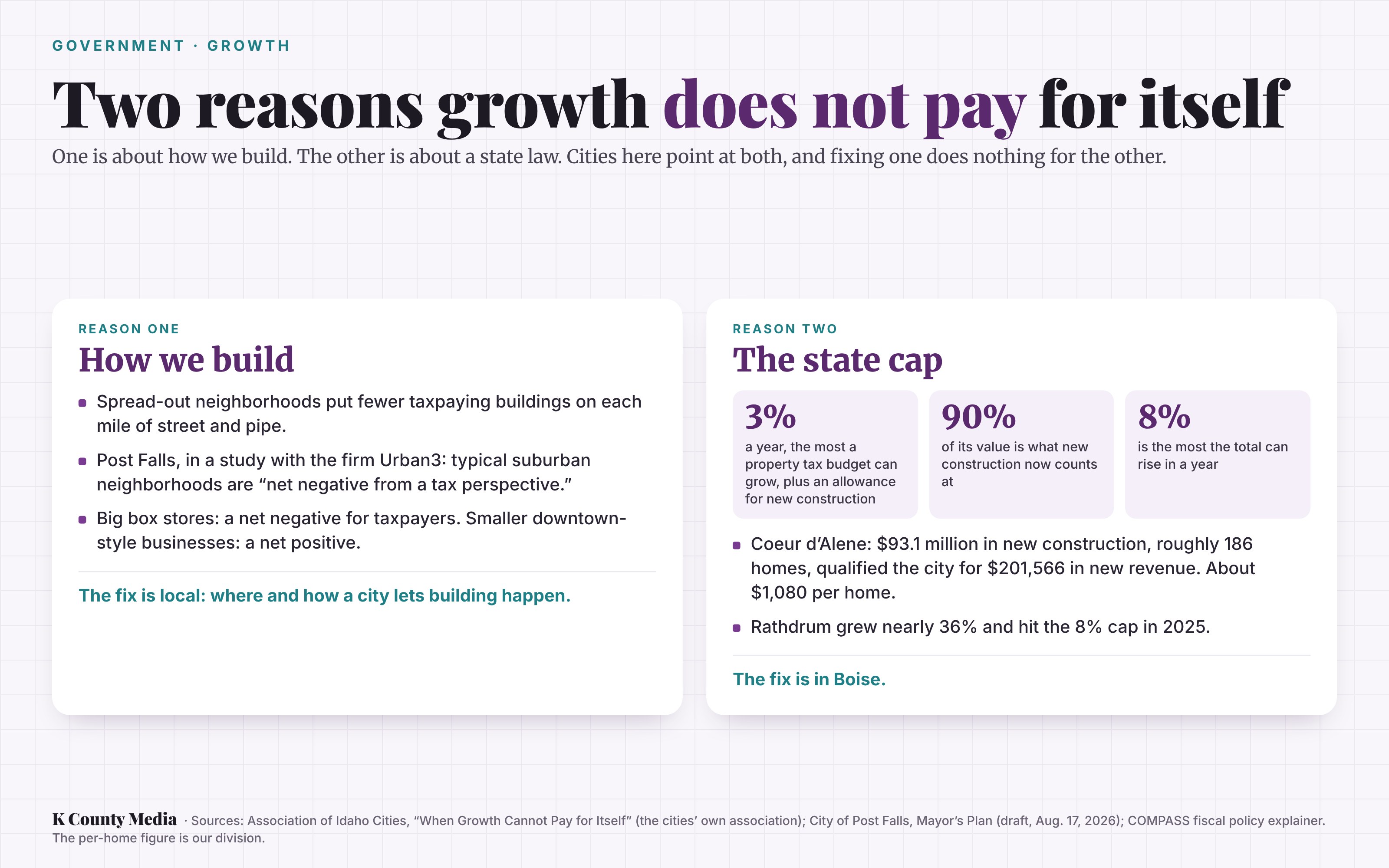
The first argument is about the shape of growth. Spread-out neighborhoods put fewer taxpaying buildings on each mile of street and pipe, so the tax they bring in may not cover the upkeep.
Post Falls put this in writing. Mayor Randy Westlund's draft plan, dated Aug. 17, says a study the city did with the firm Urban3 found typical suburban neighborhoods are "net negative from a tax perspective." It says big box stores are a net negative for taxpayers too, and smaller downtown-style businesses are a net positive. The plan recommends denser building downtown and near major streets.
- What is missing: the plan does not publish the street and utility costs behind that finding, and we did not find the Urban3 study posted as its own document.
- The other side: Arpit Gupta, who writes the newsletter Arpitrage, argued in May 2024 that all road and highway spending is 5.6% of state and local budgets, and that "suburbs are not Ponzi schemes." He agrees that aging sewers and bridges are a real cost and can strain poorer suburbs.
REASON TWO: THE STATE CAP
The second argument has nothing to do with how a neighborhood is laid out. It is about how much of the new tax base a city is allowed to collect on.
In Idaho, most local governments can raise the property tax part of their budget by 3% a year, plus an allowance for new construction and annexation. House Bill 389 changed the allowance: new construction now counts at 90% of its value, and the total increase in a year cannot pass 8%.
The Association of Idaho Cities, which speaks for city governments, lays out what that does in a paper titled "When Growth Cannot Pay for Itself." Its Kootenai County numbers:
- Coeur d'Alene: $93.1 million in new construction, roughly 186 homes, qualified the city for $201,566 in new revenue. That is about $1,080 per home.
- Post Falls: $162.2 million in new construction counted in 2025, the most of any city in the county. The city told the association it cannot afford the staff to keep up with growth without drawing on taxes it had passed up in earlier years.
- Rathdrum: grew nearly 36% and hit the 8% cap in 2025. The paper's table shows Athol and Hauser at the cap that year too.
- Hayden: city officials said existing residents are, in effect, subsidizing new construction, and warned that chip sealing roads and fixing potholes will be harder to afford.
The association asks the Legislature to count new construction at 100% again, drop the 8% cap for cities under 10,000 people, raise it to 15% for cities of 10,000 to 30,000, and keep it at 8% for cities of 30,000 or more.
Two things to know about that paper. It is written by the cities' own association, so it argues the cities' side. And the limits it objects to are the same limits that hold down how fast a city's share of a property tax bill can grow.
WHY THE DIFFERENCE MATTERS
- If reason one is the problem, the fix is local: where and how a city lets building happen.
- If reason two is the problem, the fix is in Boise.
- Building denser does not lift the state cap. Lifting the cap does not change what a mile of street costs to keep up.
The Post Falls plan names both. It calls for denser building, and it asks for changes in state law without naming a bill.
WHAT WE DO NOT KNOW
- No city in the county has published what it costs to maintain the streets in a given neighborhood, set against the tax that neighborhood pays.
- The association's paper carries no publication date. It says its data was pulled in February 2026.
HOW WE COUNTED
The city figures are from the Association of Idaho Cities paper and its table for 2025. The per-home figure is our division of $201,566 by 186 homes. The state rules are from the paper and from an explainer by COMPASS, the Boise-area planning agency, updated Nov. 4, 2026. The Post Falls quotes are from the mayor's plan on the city website.
Sources
- Association of Idaho Cities: When Growth Cannot Pay for Itself, the Municipal Impacts of Idaho H389 (2021)
- City of Post Falls: Mayor's Plan to Streamline Government (draft, Aug. 17, 2026)
- COMPASS: Idaho fiscal policy explainer (updated Nov. 4, 2026)
- Arpit Gupta, Arpitrage: Contra Strong Towns (May 18, 2024)