
There isn't just one hospice. Seven serve Kootenai County, and you get to choose
Hospice is a kind of care, not a place. Seven agencies offer it here, three nonprofit and four for-profit. Here's who owns each, how a hospice house works, and what Medicare pays.
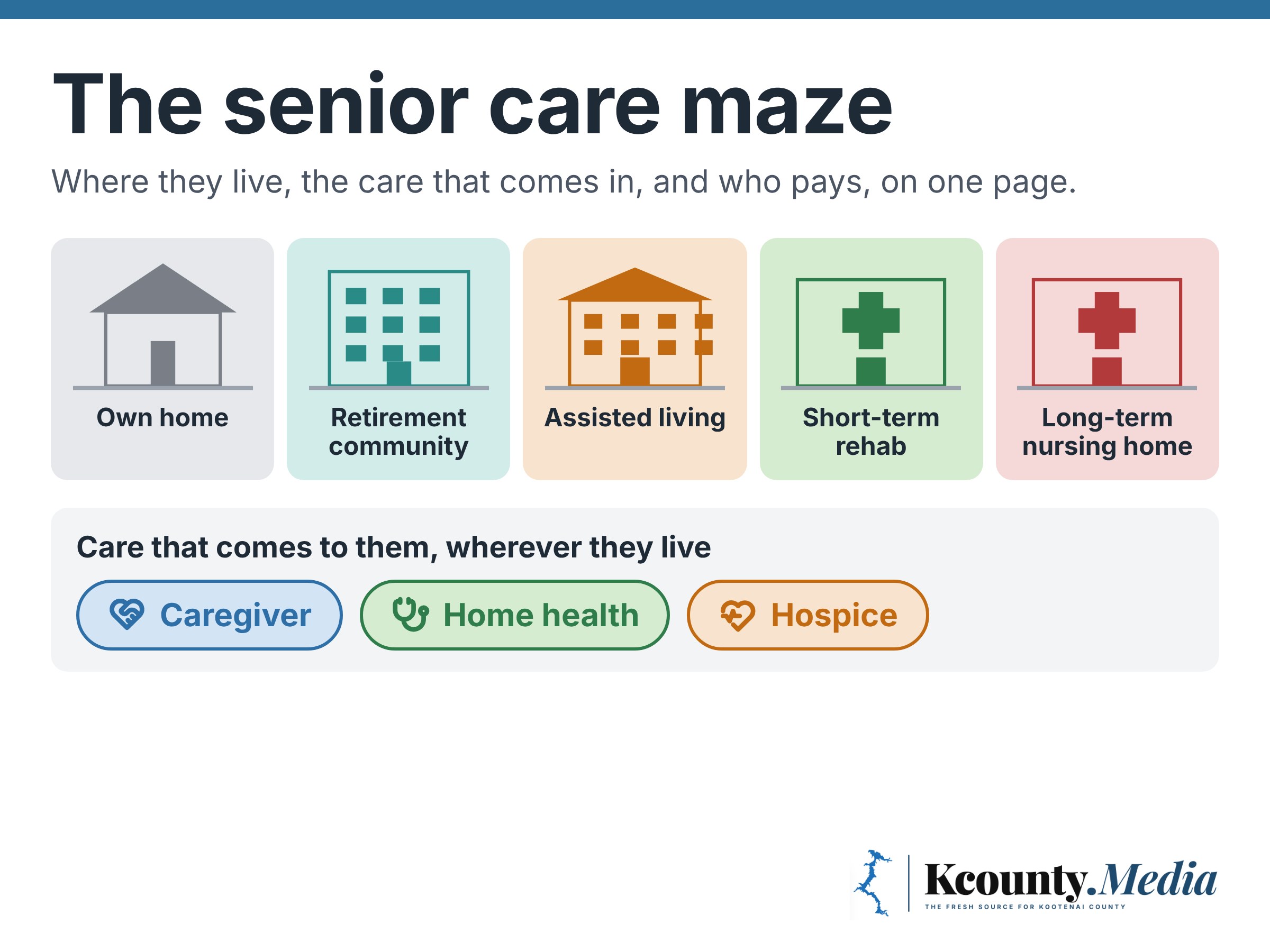
When a doctor says the word hospice, most families picture a building. That's the first thing to clear up. Hospice is not a place. It is a philosophy of care, and it comes to the patient.
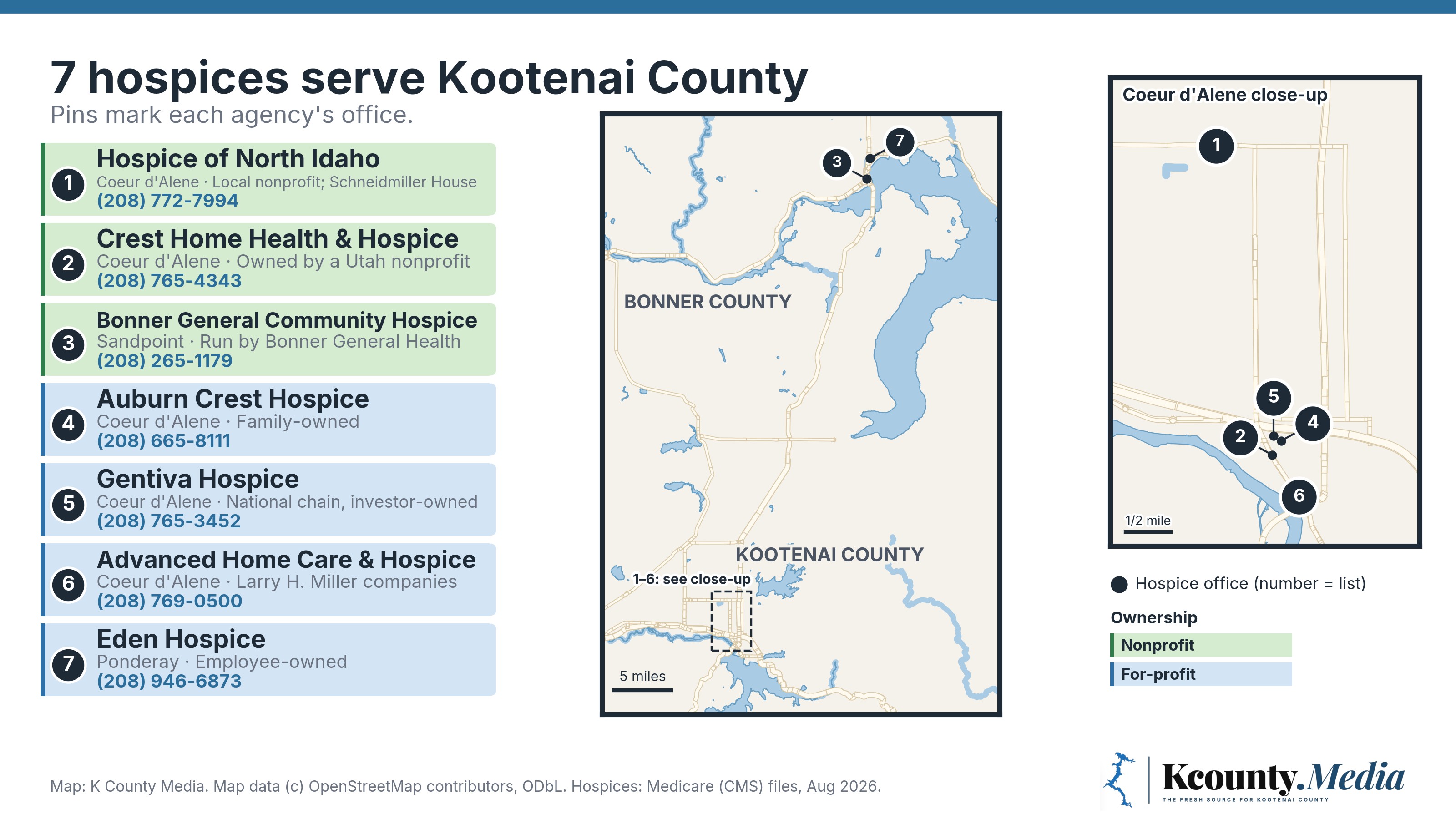
Hospice is not a place. It's a way of caring
Hospice is for someone whose doctor expects they have six months or less to live if the illness runs its normal course. The goal changes from cure to comfort. The team treats pain and other symptoms, and it looks after the whole person: body, mind and spirit. The family is part of the care too, and grief support continues after a death.
The care happens wherever the patient lives: a house, an apartment, assisted living or a nursing home. A nurse, an aide, a social worker, a chaplain and volunteers come to the patient. Hospice of North Idaho, for example, says more than 90% of its days of care happen in patients' homes.
In Kootenai County, seven different Medicare-certified agencies provide that care, and the family gets to choose which one.
What being on hospice means
Choosing hospice means choosing comfort over cure. The patient signs a statement choosing hospice care instead of other Medicare treatment for the terminal illness. From then on, Medicare won't pay for treatment meant to cure that illness. Everything for comfort is covered: nurse visits, medicine for pain and symptoms, equipment like a hospital bed, and supplies.
A few things surprise families. You can keep your own doctor on the team. Medicare still pays for health problems that aren't part of the terminal illness, like a broken wrist, with the usual deductibles and copays. And you can stop hospice at any time and go back to regular Medicare, for example to try a new treatment.
Hospice is not home health
Hospice and home health both send nurses to the house, so people mix them up. They are built for opposite goals. Medicare home health is meant to help you get better: recover from surgery, regain strength, get a condition under control. Hospice is meant to keep you comfortable when getting better is no longer the goal.
The rules follow the goals. To get Medicare home health, a doctor must certify that you need skilled care and that you are homebound, meaning leaving home is a real struggle. Hospice has no homebound rule. A hospice patient can go to church, visit family, take a trip out of town, or, if they're up for it, jump out of an airplane.
You generally can't have both at once for the same illness. Once you choose hospice, the hospice team handles all care for the terminal illness, so Medicare won't also pay a home health agency to treat it. The one exception is home health for a condition completely unrelated to the terminal illness. And if a hospice patient's health improves, they can leave hospice and start home health.
A hospice house is something different
A hospice house is a building where a hospice patient can stay for round-the-clock care. Kootenai County has one: Hospice of North Idaho's Schneidmiller House on Prairie Avenue in Coeur d'Alene, opened in 2011. It has 21 beds, and Hospice of North Idaho says it is the only inpatient hospice unit in Idaho.
A stay in a hospice house is not the same as hospice services. Any of the seven agencies can serve you at home. A hospice house is a short-term place for when care at home isn't working for a while.
How Medicare pays, and how long you can stay
Medicare pays hospice at four levels of care. Every Medicare-certified hospice has to offer all four.
Routine home care is the everyday level. The team visits wherever the patient lives. Medicare pays for the care but not for rent or room and board. If the patient lives in a nursing home or assisted living, the family or Medicaid still pays that bill.
Continuous home care keeps a nurse in the home for at least eight hours a day during a short-term crisis.
General inpatient care is the level a hospice house is built for. It is for pain or symptoms that can't be managed at home. Medicare covers it, including the room. There is no set number of days. But it is meant to be short. Medicare's rules say that once symptoms are under control, the patient must go back to the routine level of care.
Inpatient respite care gives the family caregiver a break. The patient can stay in a facility for up to five days at a time. The patient may owe up to 5% of the Medicare-approved amount.
So the honest answer to "how long can you stay?" is this: as long as the symptoms need that level of care, and no longer. When the crisis passes and the patient has not died, the patient goes home or to a care facility. Some hospice houses around the country let families stay on by paying room and board out of pocket. Ask the hospice house directly what its rule is. In Schneidmiller House's first year, the average stay was seven days.
The hospice benefit itself has no end date. It runs in benefit periods: two 90-day periods, then as many 60-day periods as needed, as long as a doctor recertifies that the patient qualifies.
Medicare's own records show seven hospices caring for patients in Kootenai County ZIP codes. Three are nonprofit and four are for-profit. They differ in who owns them, but every one of them is licensed and certified to deliver the same Medicare hospice benefit.
You choose, and you can change
Hospice usually starts with a referral from a hospital, clinic or nursing home, and that referral often names one agency. But the choice belongs to the patient and family. Medicare also gives patients the right to switch hospice providers once in each benefit period.
What "nonprofit" and "for-profit" mean here
Both kinds are paid the same way. Medicare pays a hospice a set daily rate for each patient, and the rate doesn't change with how much care that patient needs on a given day. A nonprofit puts any money left over back into its mission and answers to a community board. A for-profit answers to its owners, who can be a family, its own employees, or investors.
This has changed a lot. About 95% of hospices were nonprofit in 1990. By 2020, 73% were for-profit.
What the research shows
Researchers have studied the difference for years. Here is what they've found, in plain terms.
On average, patients stay longer in for-profit hospices. Medicare's advisory commission counted an average stay of 109 days at for-profits in 2017, compared with 67 days at nonprofits.
In a national study of family surveys, RAND researchers found that families rated for-profit hospices lower on average. They also found that quality varied widely, and that some for-profit hospices scored better than the national average. "Not all for-profit hospices provide poor quality," the study's lead author said.
Ownership is changing too. A study published Nov. 2 in Health Affairs looked at for-profit hospices that private equity firms bought. After the sale, patients stayed in hospice longer and Medicare paid more per stay, with no increase in visits.
None of this tells you about any single agency. It tells you that ownership is a fair question to ask.
Hospice is one piece of a bigger maze. Here is how it fits with everything else: where someone lives, the care that can come to them, and who pays.
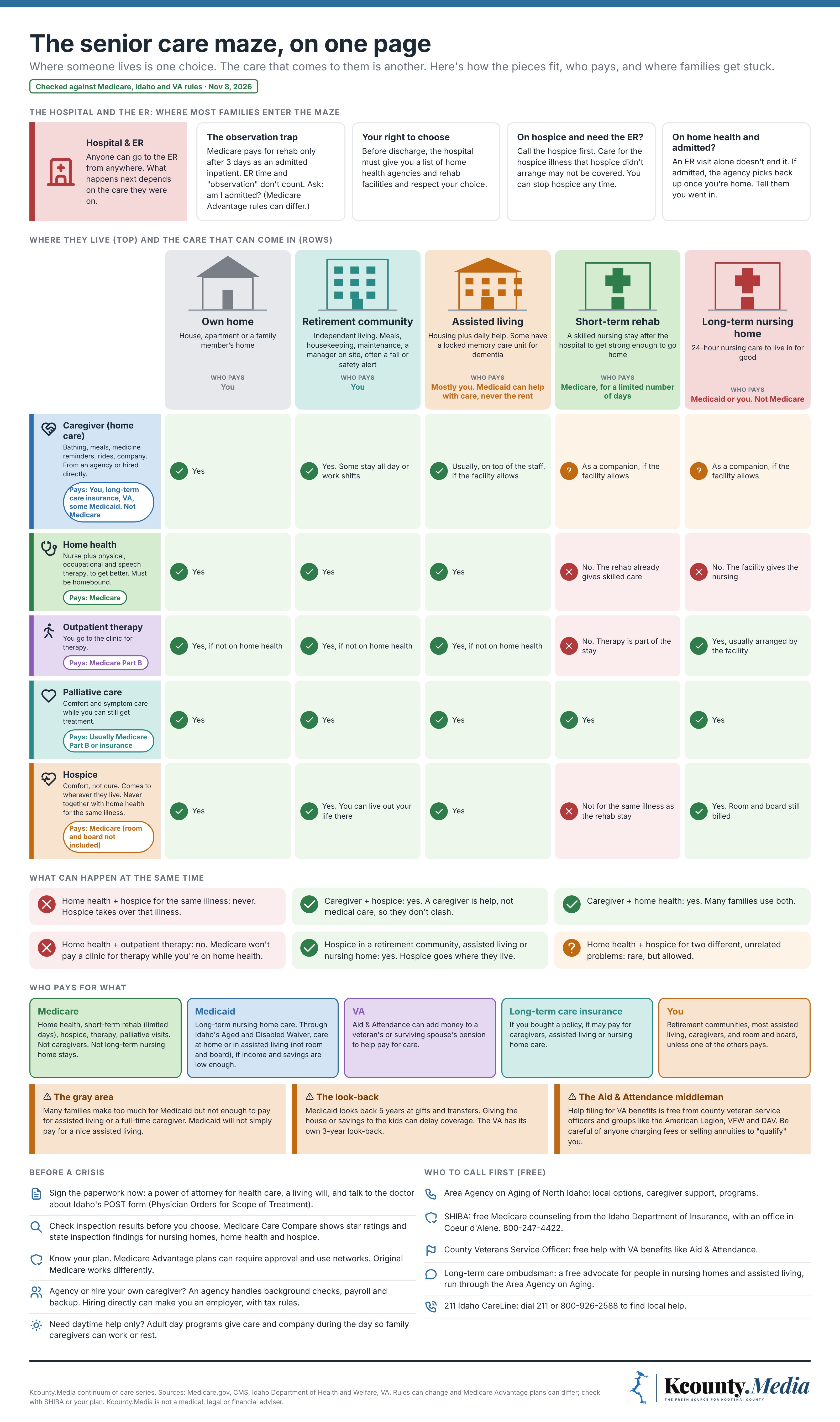
Download the senior care maze (printable PDF)
The seven hospices serving Kootenai County
Nonprofit
Hospice of North Idaho, 2290 W. Prairie Ave., Coeur d'Alene, (208) 772-7994. Founded by local volunteers in 1981 and governed by a volunteer community board. It runs Schneidmiller House, the 21-bed hospice house, and says it does not turn patients away for inability to pay.
Bonner General Health Community Hospice, 520 N. Third Ave., Sandpoint, (208) 265-1179. Run by Bonner General Health, the nonprofit hospital in Sandpoint. It mainly serves Bonner and Boundary counties, and Medicare records show it also caring for patients in Hayden, Post Falls and Spirit Lake.
Crest Home Health and Hospice, 2100 Northwest Blvd., Suite 120, Coeur d'Alene, (208) 765-4343. Medicare lists it as nonprofit. It is owned by Vali Division of Wasatch, a Utah 501(c)(3) charity.
For-profit
Auburn Crest Hospice, 1221 W. Ironwood Dr., Suite 102, Coeur d'Alene, (208) 665-8111. Family-owned. Medicare's ownership records list members of the Fletcher family behind its parent company, and its local office has been certified since 2008.
Gentiva Hospice, 1321 N. Northwood Center Ct., Suite A, Coeur d'Alene, (208) 765-3452. Formerly Kindred Hospice. It has been majority-owned by the private investment firm Clayton, Dubilier & Rice since August 2022. Humana agreed in June to sell its remaining minority stake.
Advanced Home Care and Hospice of Coeur d'Alene, 1450 Northwest Blvd., Suite 103, Coeur d'Alene, (208) 769-0500. Part of Advanced Health Care, which the Larry H. Miller Group of Companies in Utah announced it had bought in January 2021.
Eden Hospice at the Inland Northwest, 676 N. Triangle Dr., Ponderay, (208) 946-6873. The newest of the seven, certified in 2023. It is employee-owned through its parent company, EmpRes Healthcare.
Questions worth asking any hospice
Who owns you, and are you nonprofit or for-profit?
How often will a nurse visit, and who answers the phone at 2 a.m.?
How fast can someone come to the house in a crisis?
Do you have a place for inpatient or respite care if it's needed?
What support do you give the family after a death, and for how long?
You can also compare all seven side by side on Medicare's Care Compare website, which posts family survey scores for each hospice.
Coming up
This is the first story in a Kcounty.Media series on care for older adults in Kootenai County. Next, we'll cover Medicare home health: who qualifies, what it pays for and what it doesn't. After that, we'll cover skilled nursing facilities and rehab centers, and the difference between a short-term rehab stay and long-term nursing home care, including what Medicare covers and what it leaves to families. We'll also explain how skilled nursing, assisted living and a retirement home differ. They are three separate things that serve three different purposes.
How we reported this
We built the list from Medicare's provider files: the hospice directory, the ZIP code service data and the ownership records released in August 2026. A few agencies from far outside the region showed up for a single ZIP code and are not listed here. Addresses and phone numbers are as Medicare lists them. Ownership details come from those records and from each organization's public filings and announcements.
The writer was once marketing director for two for-profit hospices in the region.
Sources
- CMS: Hospice General Information (Medicare directory, Aug 2026)
- CMS: Hospice ZIP Data (where each hospice served patients)
- CMS: Hospice All Owners (ownership records)
- CGS (Medicare contractor): home health and hospice at the same time
- Medicare Interactive: changing hospice providers, benefit periods
- CGS (Medicare contractor): general inpatient care, return to routine care once stabilized
- NHPCO: General Inpatient care FAQ (no set day limit)
- Medicare.gov: Hospice care coverage (what's covered, curative care, unrelated conditions, stopping hospice)
- Spokane Journal: Schneidmiller House, care mostly in homes
- Coeur d'Alene Chamber: Hospice of North Idaho, 21-bed inpatient unit, volunteer board
- Coeur d'Alene Press (2012): Hospice House first year, average stay
- Health Affairs (Nov 2 2026): hospice changes after private equity acquisition
- Medicare Interactive: the home health homebound requirement
- MedPAC (Dec 2018): length of stay by ownership, 2017
- Gilchrist: nonprofit share of hospices in 1990, for-profit growth
- Sandpoint Living Local: history of Bonner General Health Community Hospice
- GrantWatch: Vali Division of Wasatch, Utah 501(c)(3)
- HealthDay on RAND study (2023): 30% of hospices for-profit in 2000, 73% in 2020
- HomeCare Magazine: Humana selling Gentiva stake; CD&R majority since 2022
- Larry H. Miller Group acquires Advanced Health Care (Jan 2021)