
The senior care maze: how it all fits together in Kootenai County
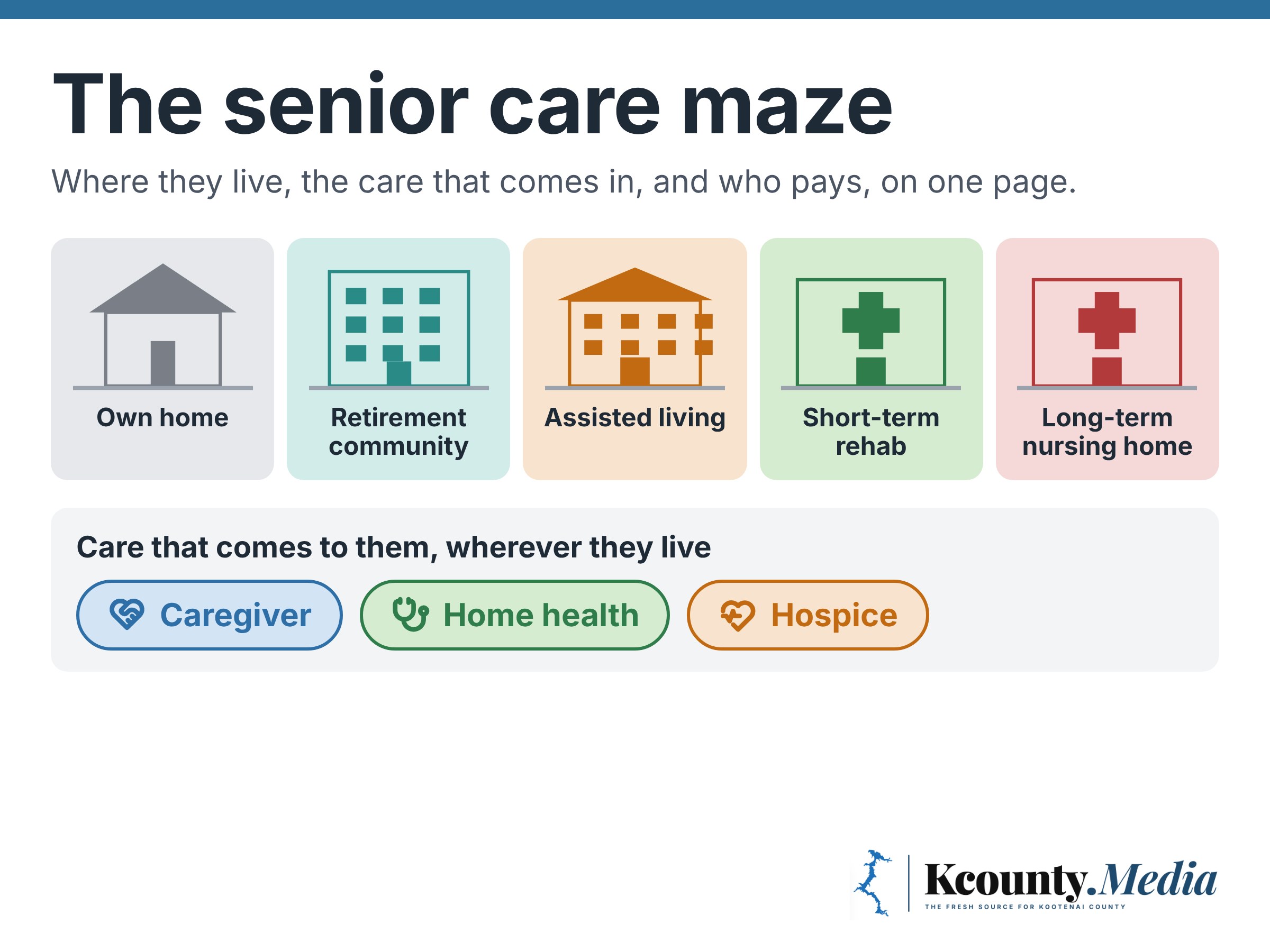
Where someone lives and the care that comes to them are two separate choices. Here is the whole map, who pays for each piece, and where families get stuck.
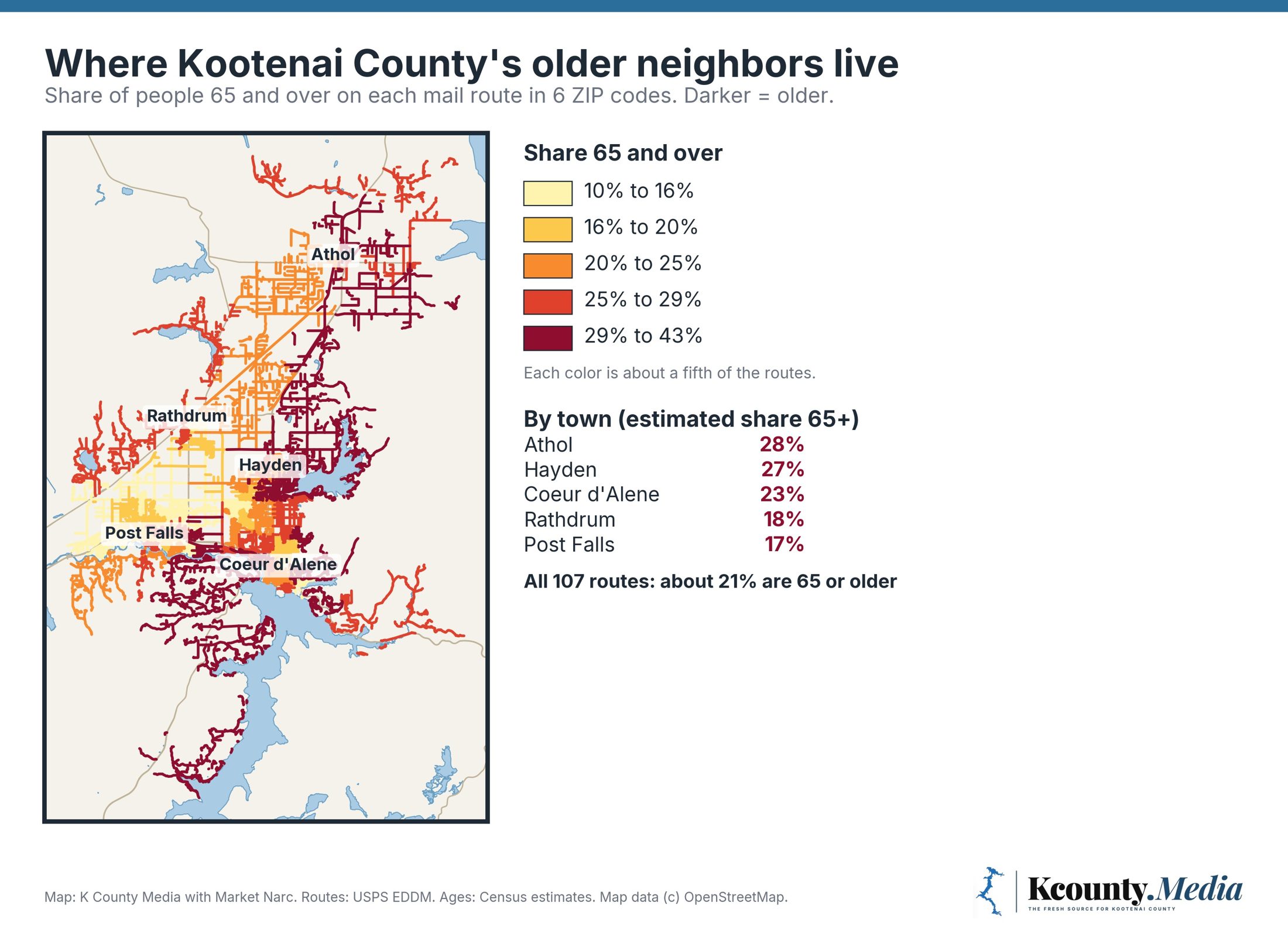
About one in five people on the mail routes we mapped in Coeur d’Alene, Post Falls, Hayden, Rathdrum and Athol is 65 or older. In some neighborhoods it is closer to two in five. That means most families here will walk through the senior care maze at some point, for a parent or for themselves.
The maze is not as hard as it looks once you see one thing: where someone lives is one choice, and the care that comes to them is another. Most of the confusion, and a lot of wasted money, comes from mixing those two up.
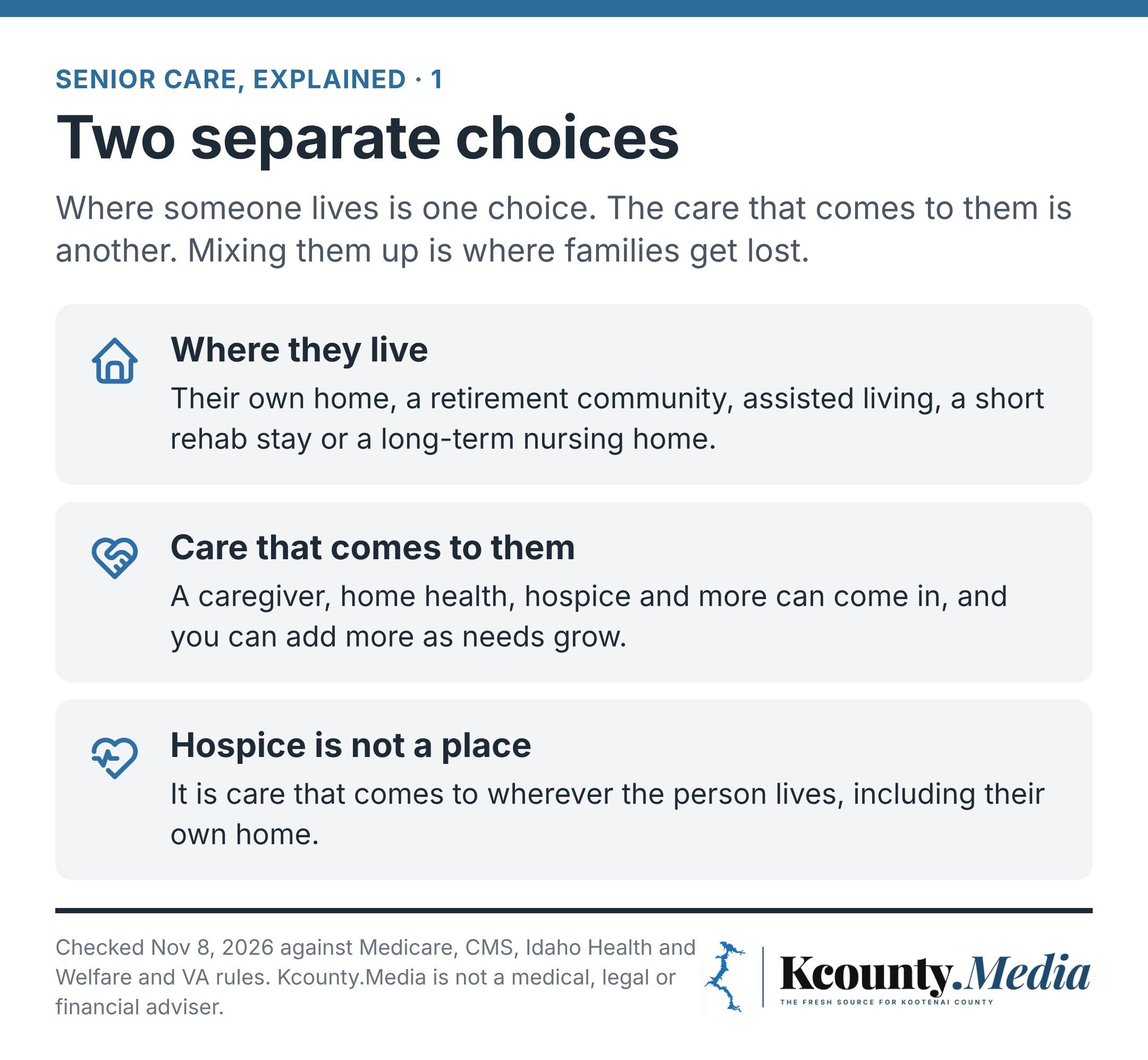
Where they live
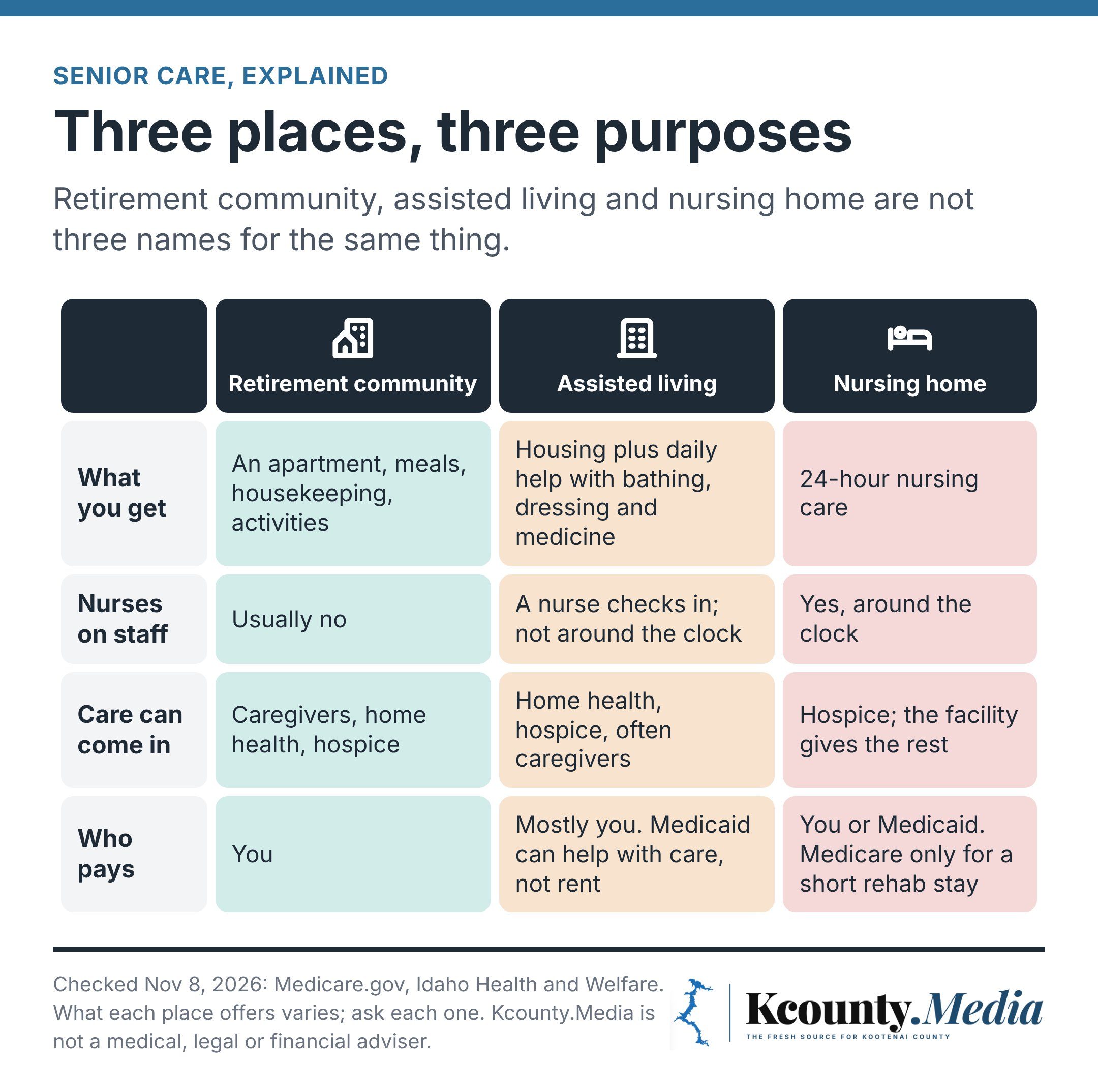
There are five main places. A person’s own home, a house or apartment, or a family member’s. A retirement community, which is independent living with meals, housekeeping and someone on site. Assisted living, which is housing plus daily help with things like bathing, dressing and medicine. A short-term rehab stay in a skilled nursing facility after a hospital stay. And a long-term nursing home, with nursing care around the clock.
Retirement community, assisted living and nursing home are not three names for the same thing. Each serves a different purpose, and each is paid for differently.
The care that comes to them
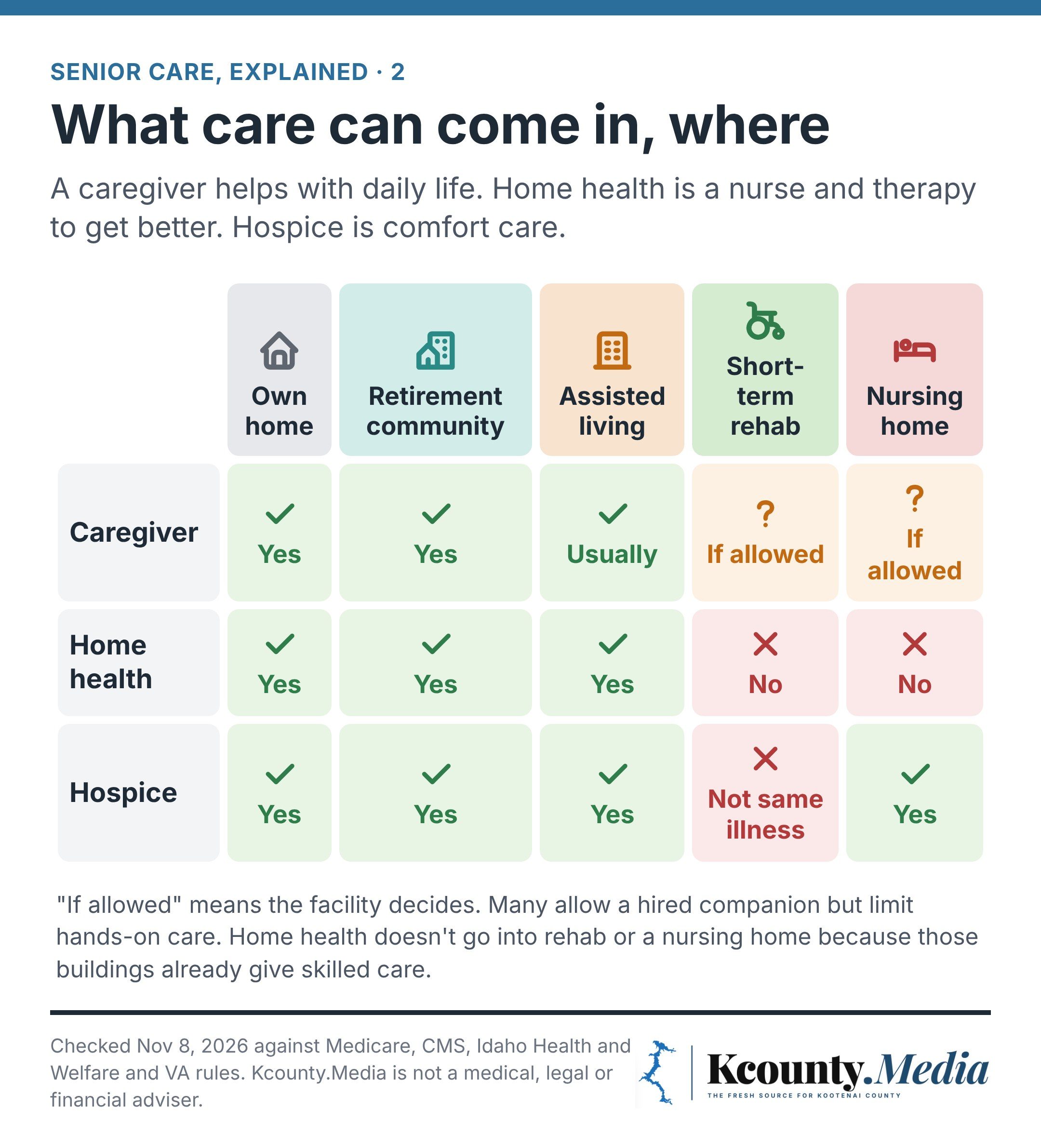
Then there is care that comes in, wherever the person lives. A caregiver from a home care agency, or one you hire, helps with daily life. Home health sends a nurse and therapists to help someone get better after an illness or surgery. Hospice brings comfort care when a cure is no longer the goal. Palliative care helps with symptoms while treatment goes on.
This is the part that surprises people: you can live your whole life out in a retirement community and die there on hospice. You can get home health in assisted living. You can add a caregiver almost anywhere. The care follows the person.
What mixes and what does not
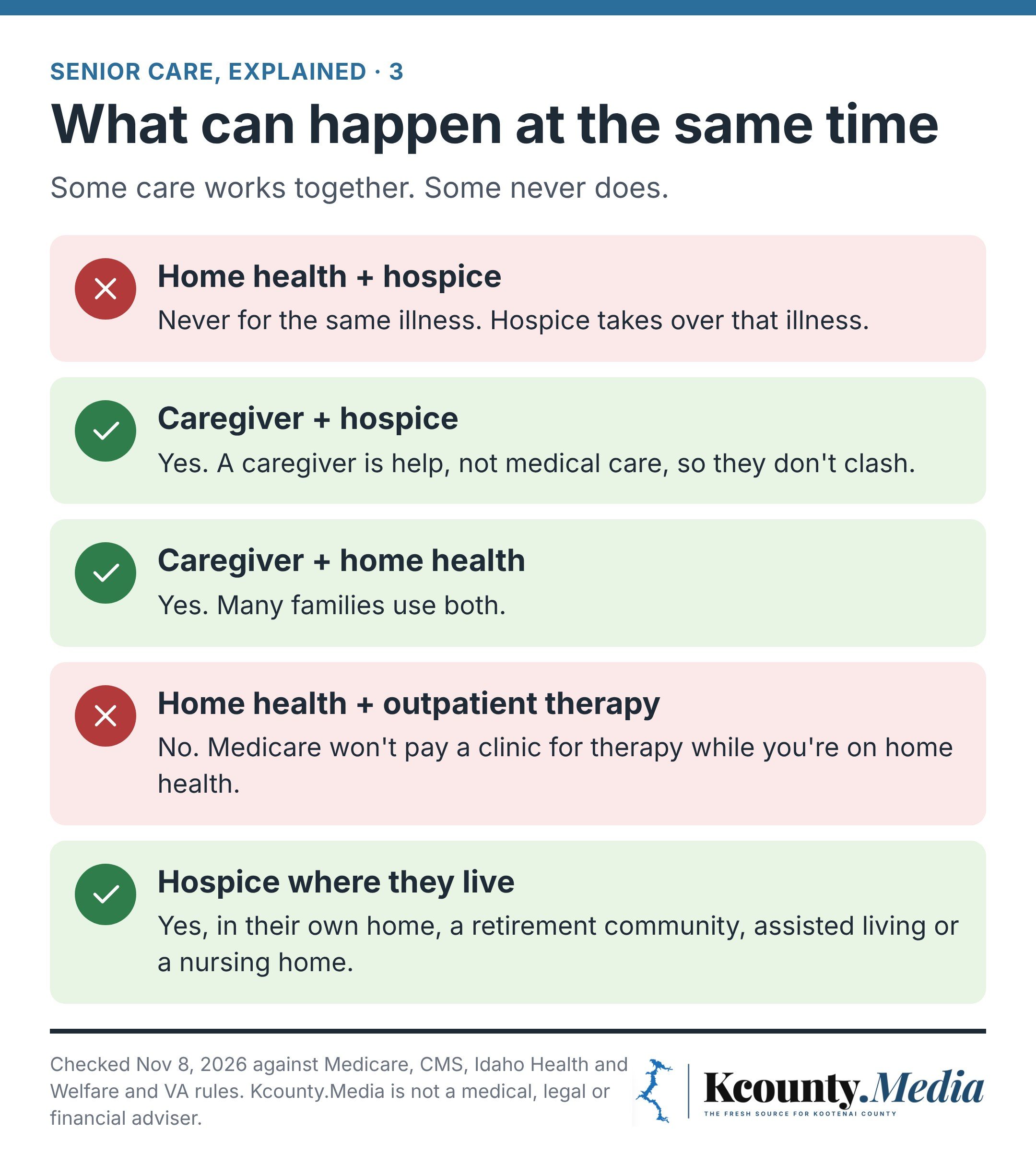
Some combinations are off limits. Home health and hospice cannot both cover the same illness at the same time; hospice takes over that illness. Home health does not come into a skilled nursing facility, because the facility already gives skilled care. And Medicare will not pay for outpatient therapy at a clinic while someone is on home health, because therapy is part of home health.
The hospital is where most families enter
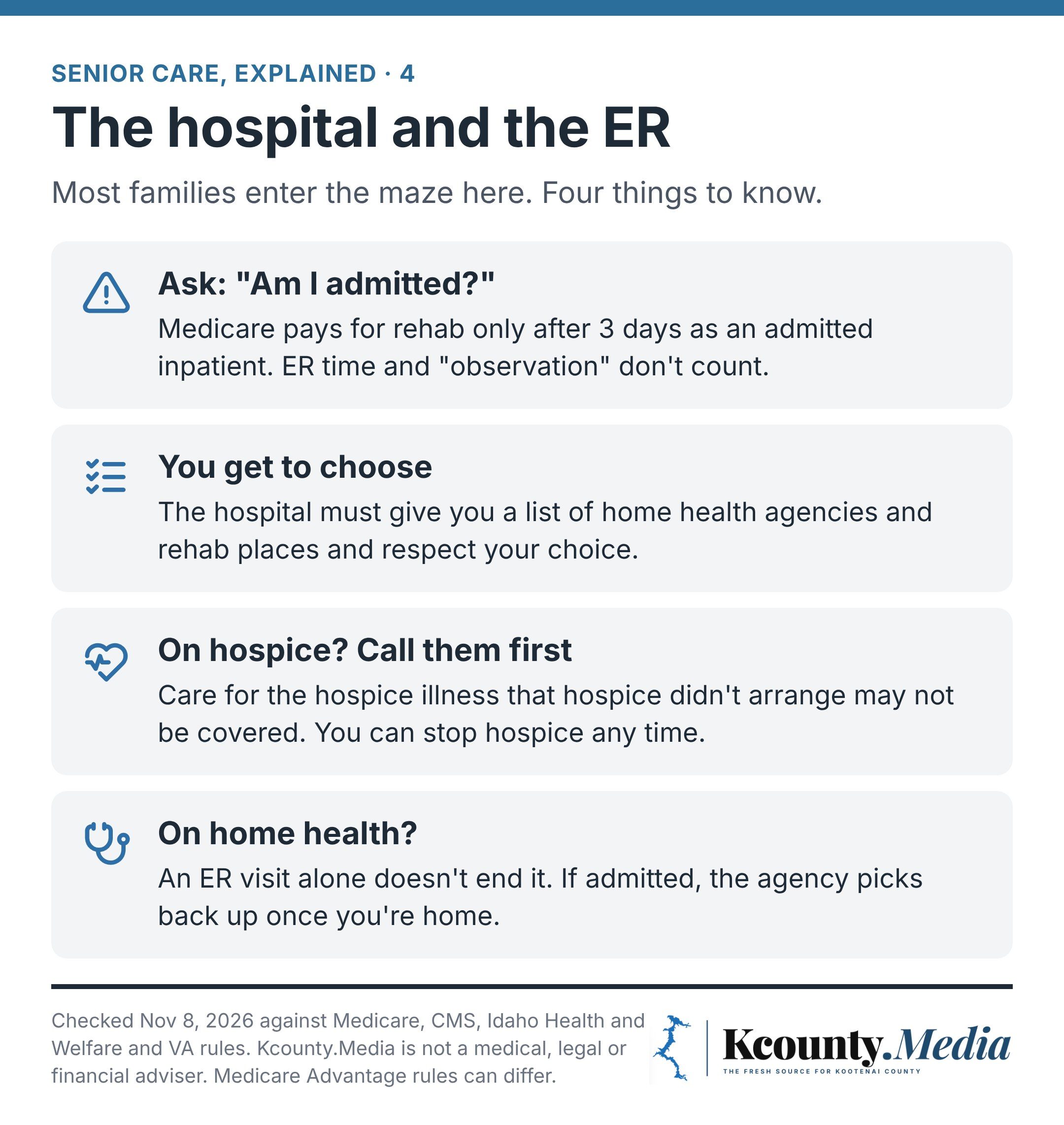
Many families meet the maze in an emergency room. Two rules matter most there. Medicare pays for a rehab stay only after three days as an admitted inpatient, and time in the ER or under “observation” does not count. And before discharge, the hospital must give you a list of home health agencies and rehab facilities and respect your choice.
Who pays for what
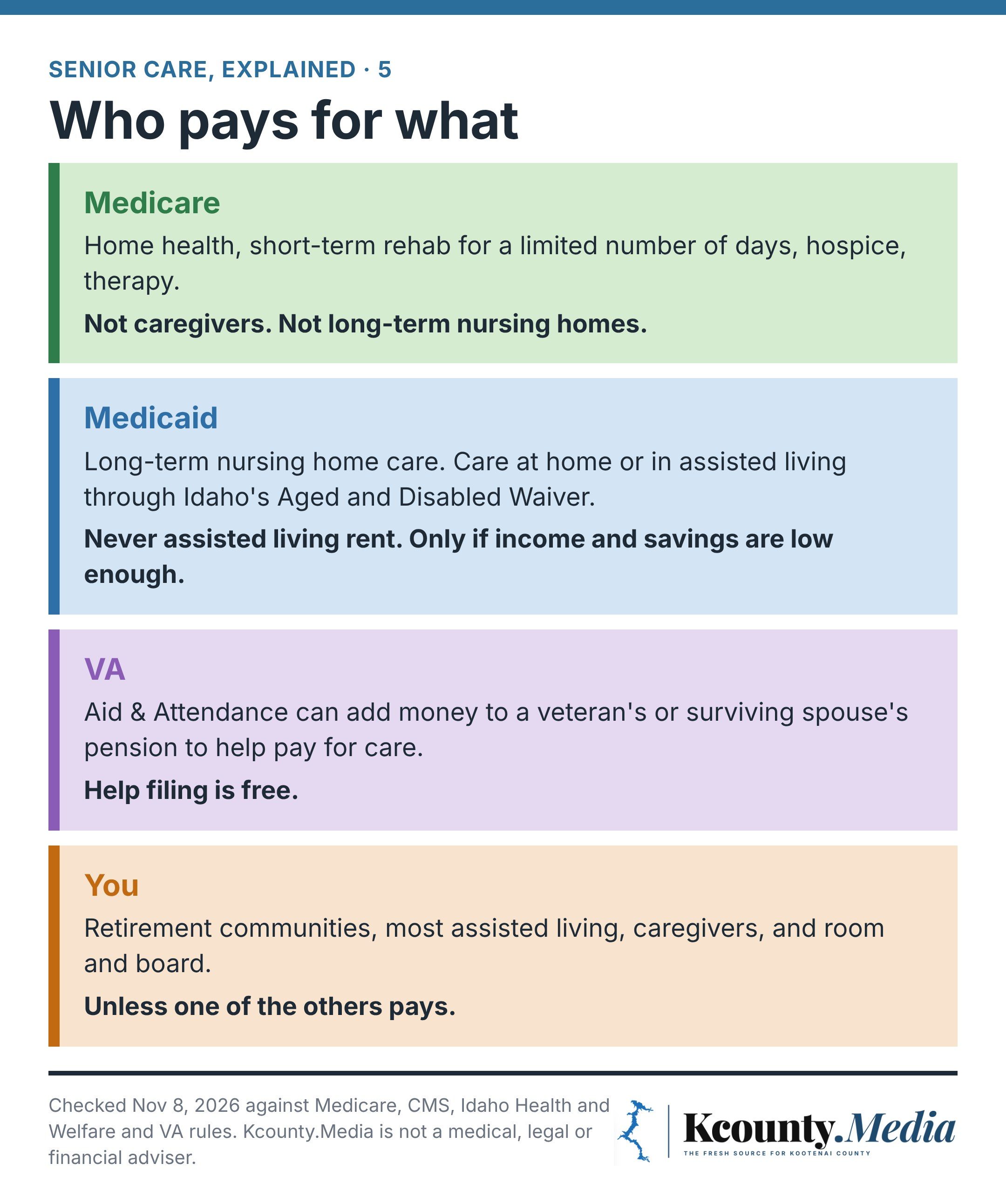
Medicare pays for medical care that helps someone get better or stay comfortable: home health, a limited rehab stay, hospice and therapy. Medicare does not pay for caregivers or for living in a nursing home long-term. Medicaid can pay for a long-term nursing home stay, and for some care at home or in assisted living, but never the rent. Veterans may have VA help. Long-term care insurance pays if you bought a policy. Everything else is paid by the family.
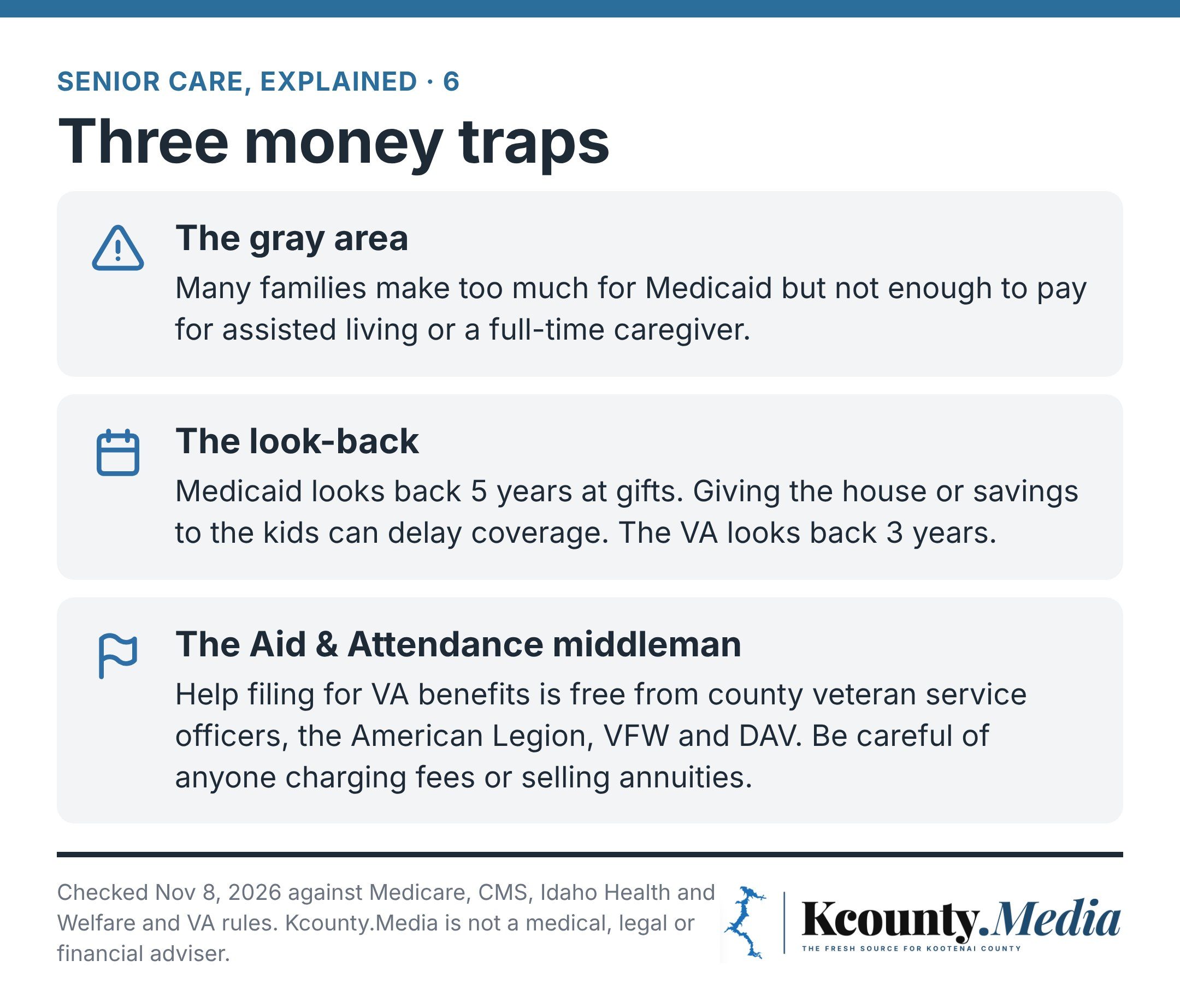
The three money traps
Many families make too much to qualify for Medicaid but not enough to pay for assisted living or a full-time caregiver. Medicaid looks back five years at money and property given away. And veterans’ families are often pitched paid “help” with Aid & Attendance that is free from a county veterans service officer.
Who is here to help
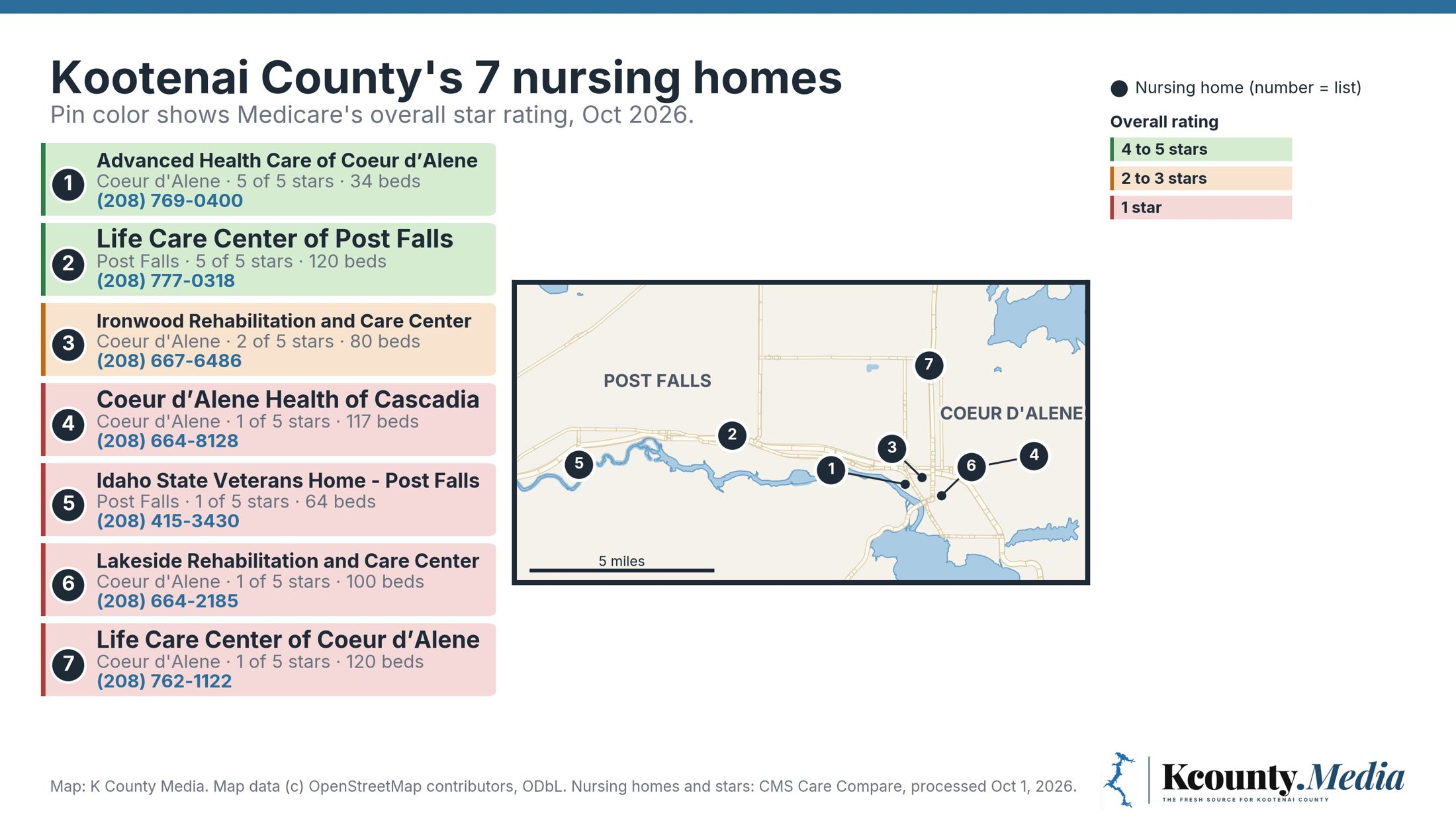
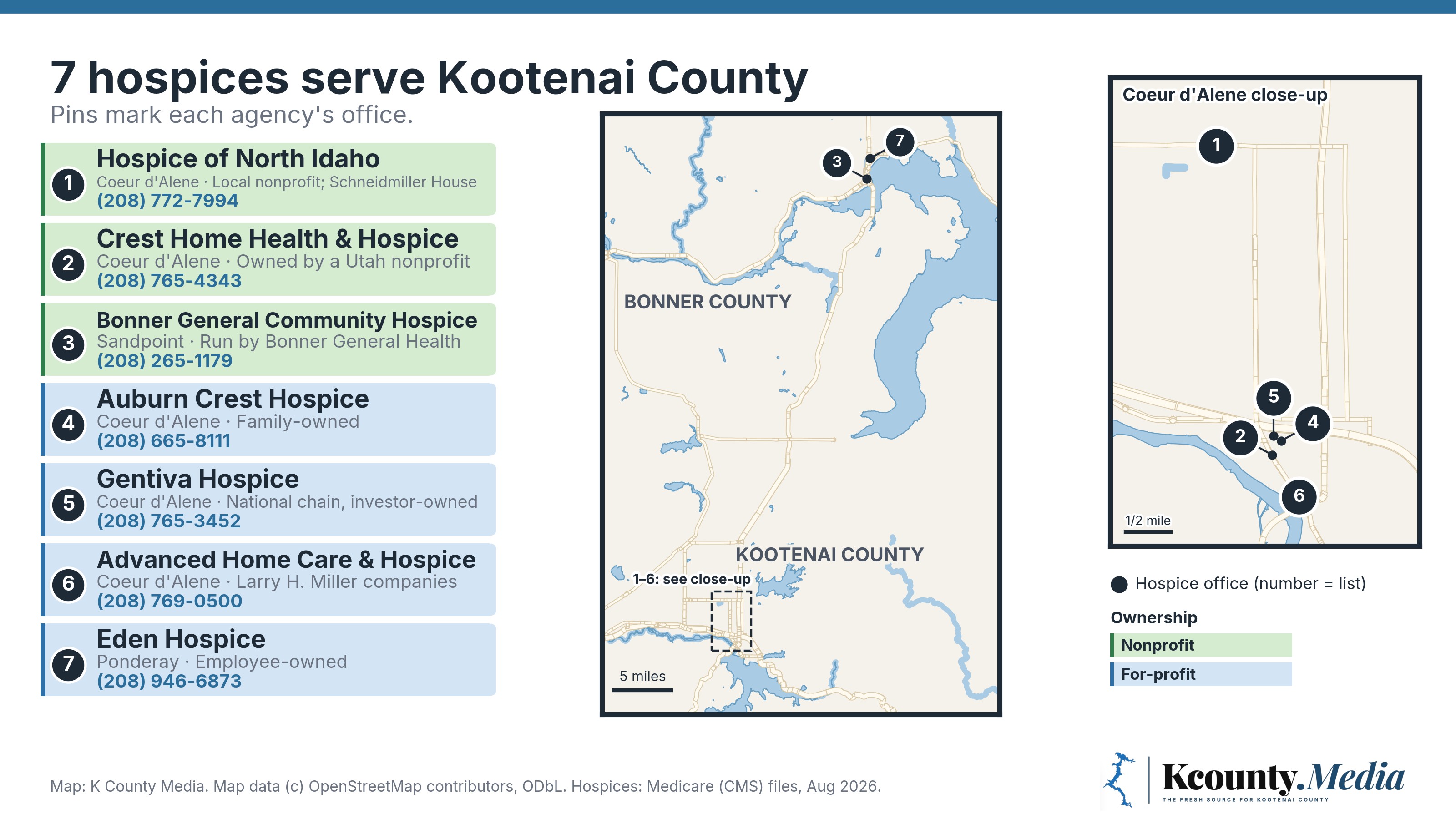
Kootenai County has seven nursing homes, eleven Medicare-certified home health agencies that list our ZIP codes, and seven hospices serving the county. Medicare rates each one and posts every inspection at Medicare.gov Care Compare.
The whole maze on one page
We put everything above on one poster. Print it and keep it on the fridge.
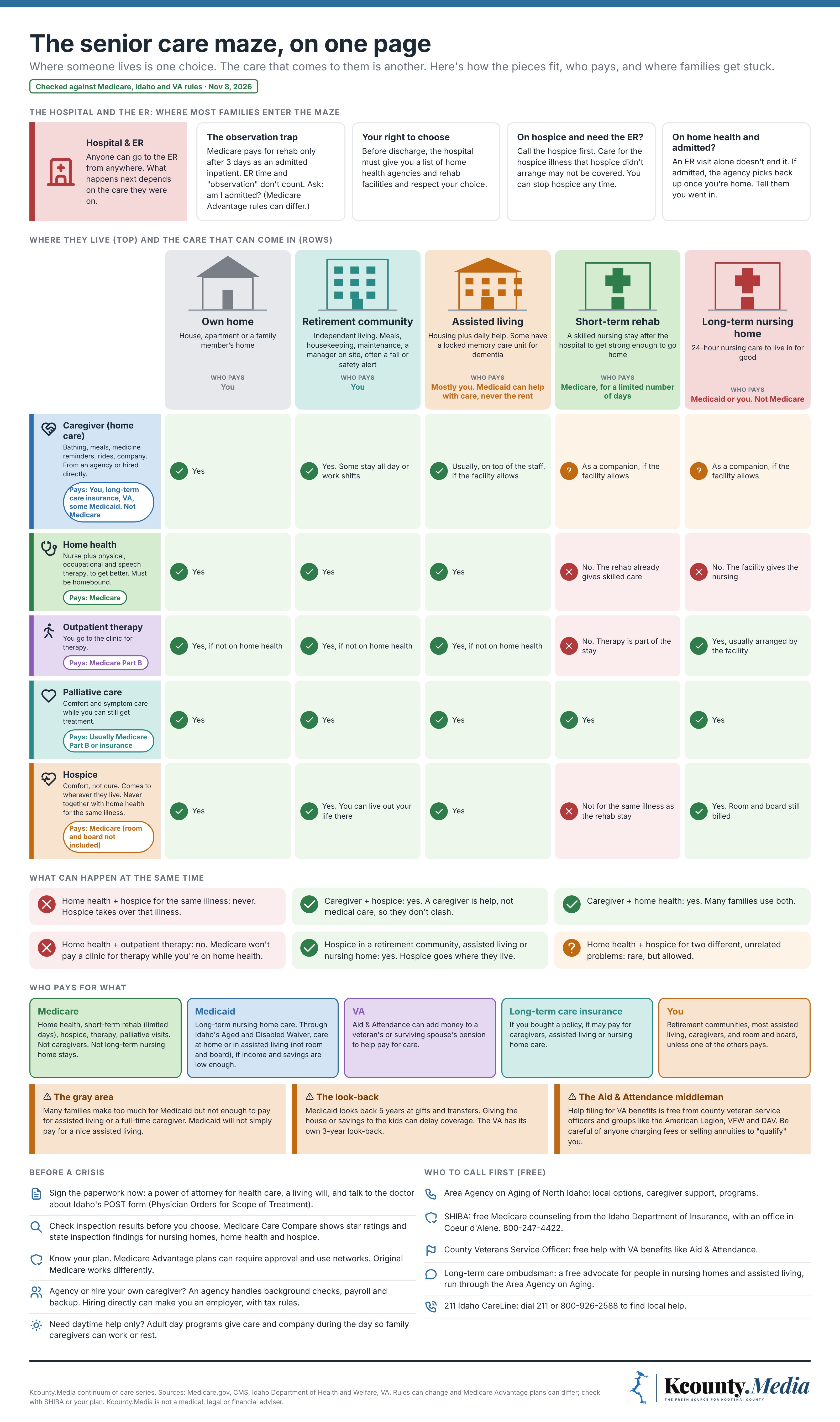
Download the senior care maze (printable PDF)
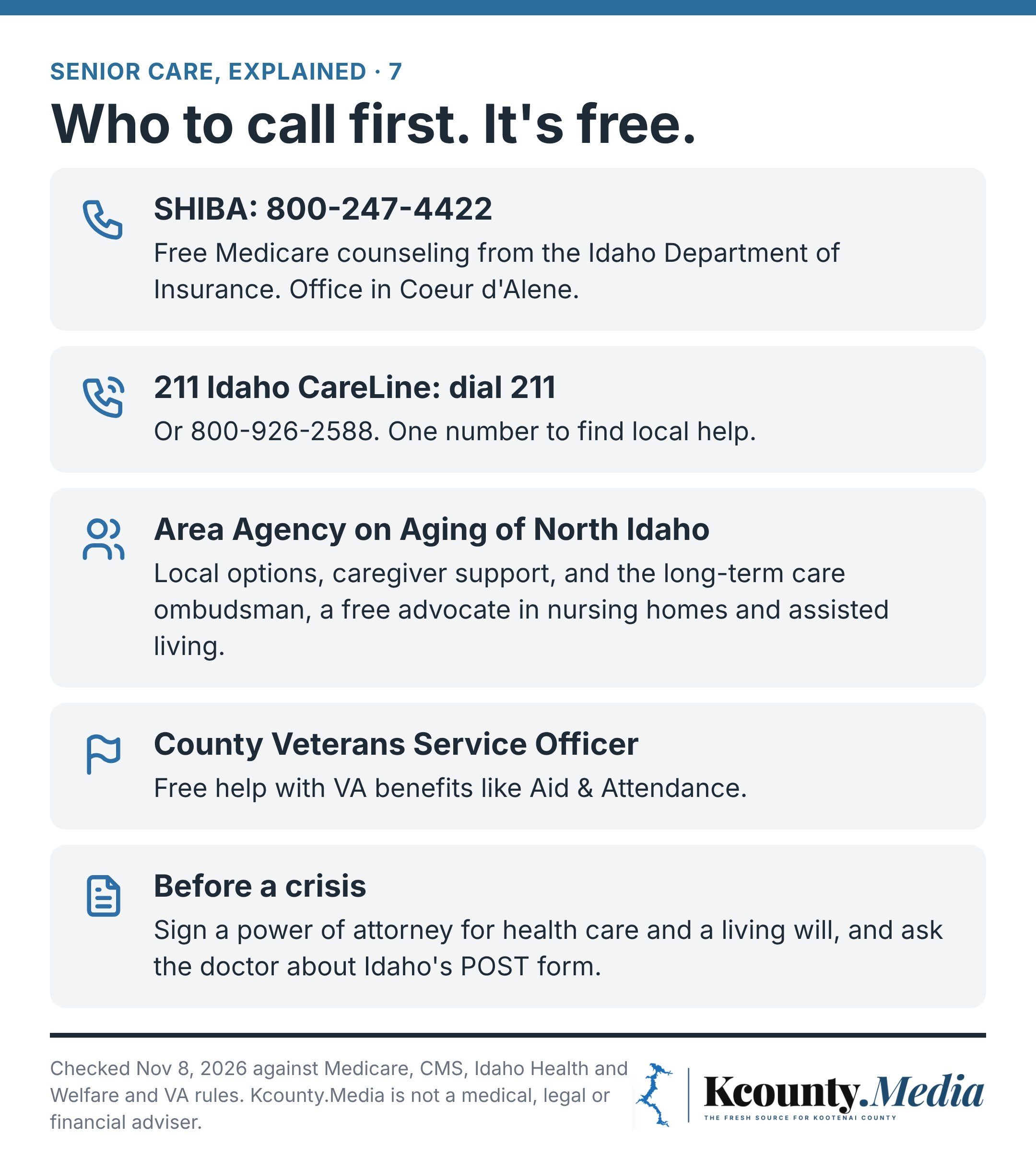
Who to call first
Start with the free help. SHIBA gives free Medicare counseling, at 800-247-4422. The Area Agency on Aging of North Idaho knows the local options and runs the long-term care ombudsman program, at 208-667-3179. Veterans can call Kootenai County Veterans Services at 208-446-1090. And 211 connects you to almost anything else.
The rest of the series
This story is the map. The rest of the series walks through each piece: home health, home care, the three kinds of places, rehab versus long-term nursing care, what mixes, the ER, the observation trap, the gray area, the look-back, Aid & Attendance, inspections, where to start, and the paperwork to sign before a crisis. Our story on choosing a hospice is already up.
Part of Kcounty.Media’s series on senior care in Kootenai County. Every number was checked against Medicare, Idaho or VA sources on Nov. 8, 2026. Rules change, and Medicare Advantage plans can work differently; when in doubt, call SHIBA at 800-247-4422 for free Medicare help.
The writer has worked in hospice, assisted living, skilled nursing and a retirement home, and was once marketing director for two for-profit hospices in the region.
Sources
- Medicare.gov: Home health services
- Medicare.gov: Skilled nursing facility care
- Medicare.gov: Hospice care
- Medicare.gov: Inpatient or outpatient hospital status
- 42 CFR 409.30: the 3-day hospital stay rule
- 42 CFR 482.43: hospital discharge planning and patient choice
- CMS: 2026 Medicare Parts A & B premiums and deductibles
- CMS Provider Data: Nursing home provider information (processed Oct 1, 2026)
- CMS Provider Data: Home health care agencies
- CMS: 2026 SSI and spousal impoverishment standards
- IDAPA 16.03.22: Idaho residential assisted living facility rules
- VA: Aid and Attendance benefits and Housebound allowance
- Area Agency on Aging of North Idaho
- Idaho Department of Insurance: SHIBA
- Kootenai County Veterans Services
- 211 Idaho CareLine
- Kcounty.Media with Market Narc: USPS carrier routes and Census age estimates, 6 ZIP codes