
The Post Falls mayor's plan: the city says it will be $16.8 million short every year by 2035
Mayor Randy Westlund's draft plan names four ways to close the gap: run leaner, bring in more money, cut services and change state law. He is asking residents to weigh in before he takes it to the City Council.
Post Falls balances its budget today. The city's own 10-year forecast says that will not last.
In a plan dated Aug. 17, Mayor Randy Westlund wrote that the city is on track for a deficit of $16.8 million a year by 2035. That figure assumes the city raises its property tax levy by the 3% state law allows every year and adds no new positions, including no new police officers. If the city hires to keep up with growth, the forecast gap is $26.9 million a year.
The document is titled "Mayor's Plan to Streamline Government." Westlund calls it a draft and says he wants public input before he asks the City Council to adopt it. Here is what it says, in the city's own numbers.
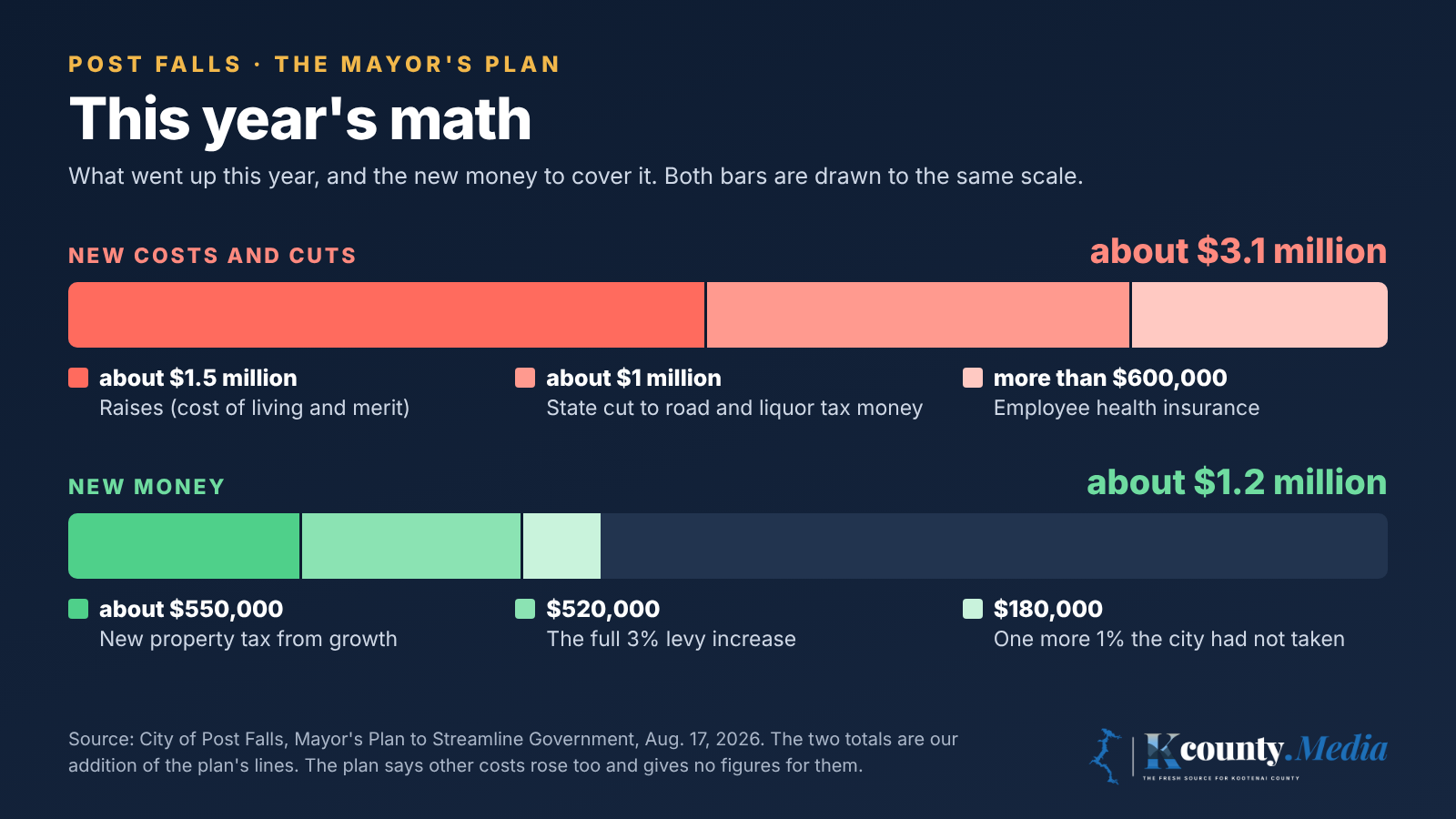
THIS YEAR'S MATH
The plan lists what went up this year and what came in to cover it.
- Employee health insurance: up more than $600,000.
- Cost-of-living and merit raises: about $1.5 million.
- State transportation and liquor tax money: cut by about $1 million.
- New property tax from growth, meaning new taxpayers: about $550,000.
- The full 3% levy increase: $520,000.
- One more 1% from taxes the city was allowed to take in earlier years and did not: $180,000.
The three money-in lines add up to about $1.2 million. The three cost lines add up to about $3.1 million, and the plan says insurance, software, electricity, gasoline and street repair cost more too. In the mayor's words, that leaves the city "significantly short, even with the maximum tax increase."
HOW IT GOT HERE
The plan points to three things.
- From 2009 to 2024 the City Council took no increase on the existing tax levy. Through 2026 the levy on existing residents rose 7%. The plan puts inflation since 2009 at about 56%.
- Property tax is about a third of the city's general fund, so a 3% levy increase raises general fund money by about 1% a year.
- Idaho's property tax system has no built-in adjustment for inflation.
Westlund uses his own house as the example. His total 2025 property tax bill was $1,550. About 37% of it, $572 a year, went to the City of Post Falls. A 3% city increase adds about $17 a year to that bill.
WHAT THE CITY'S GROWTH STUDY FOUND
The plan says the city completed a study with Urban3, a firm that measures how much tax each kind of development brings in. The plan reports three findings:
- Typical suburban neighborhoods are "net negative from a tax perspective."
- Big box stores are a net negative for taxpayers, and smaller downtown-style businesses are a net positive.
- City infrastructure is "dramatically under-funded and only looks okay now because much of it is new."
The plan's conclusion: "Our growth pattern is not sustainable." It recommends denser building downtown and near major streets instead of spreading across the prairie.
The plan does not publish the street and utility costs behind the "net negative" finding, and we did not find the Urban3 study posted as its own document.
THE FOUR STRATEGIES
1. Run leaner. Check whether a job is still needed before refilling it (the plan says one position has been eliminated this way). Sell city-owned parcels the city does not need. Start an employee-led savings program. Keep vehicles longer. Use AI tools and more volunteers in place of added staff.
2. Bring in more money. Go after more grants. Review whether fees for things like building permits and recreation programs cover the full cost. Build denser. On taxes, the plan says the council will "likely need to take the 3% inflation adjustment for the foreseeable future" and may need to consider higher franchise fees, which it describes as "effectively a sales tax paid on gas and electric utility bills."
3. Reduce services. City staff would list every program, estimate what each costs and rank them. The council would then work through the list in workshops and choose what to cut. The plan does not name any service to cut.
4. Change state law. The plan asks for changes at the Legislature and names no bill. It says any fix "should keep local voters in control of their own local budgets" and will likely take several years.
WHAT THE COUNCIL DID IN AUGUST
The same week the plan came out, the City Council unanimously approved a budget with a 7% property tax increase over two years, Kootenai County News reported: a 4% increase to the ongoing levy and a one-time 3%. The first-year money, $549,821, goes to the police department expansion. On a home assessed at $650,000 the increase is $2.14 a month the first year and 97 cents a month after that.
OTHER VIEWS
- Councilman Nathan Ziegler said inflation is the "biggest driver" of the increase, according to Kootenai County News.
- One resident testified at the budget hearing, and he opposed the tax increase, the same report said.
- In the 2025 mayor's race, candidate Scot Haug, a retired Post Falls police chief, told the Inlander, "I believe in my first term that I could cut $1 million out of the city budget and not reduce services."
- Then-Mayor Ron Jacobson ran on moving away from the kind of density the plan now favors. He told the Inlander he had asked to get rid of the city's Smart Code, which he blamed for apartment construction, and said, "We need to make sure that we don't allow growth to infringe on our existing neighbors."
- Charles Marohn, founder of the national group Strong Towns, praised Westlund for publishing the forecast and added, "I don't agree with every conclusion he reaches."
WHAT HAPPENS NEXT
- The plan says residents will be asked through online surveys, in-person workshops and a public hearing. It gives no dates.
- After that, Westlund says he will bring the plan to the City Council for formal adoption. As of Nov. 10 we did not find a council vote on it.
- The plan says the work "will take years."
HOW WE COUNTED
Every city number above is from the mayor's plan as posted on the City of Post Falls website, read Nov. 10, 2026. The two totals in "This year's math" are our addition of the plan's own lines. The August budget details are from Kootenai County News, which credits the Coeur d'Alene Press for the mayor's remarks at that meeting.
Sources
- City of Post Falls: Mayor's Plan to Streamline Government (draft, Aug. 17, 2026)
- Kootenai County News: Post Falls council approves budget with 7% tax increase to fund police expansion (Aug. 20, 2026)
- Inlander: Three candidates running for Post Falls mayor focus on growth and the city budget (Oct. 30, 2025)
- Strong Towns: A Mayor Willing to Tell His City the Truth (Aug. 24, 2026)