
How Hayden grew: from orchard crossroads to a city of 17,000
Hayden has grown more than thirteenfold since 1970, and its biggest neighborhood, Hayden Canyon, is still going up. Here's what's being built, what homes cost, and the sewer fight that comes with growth.
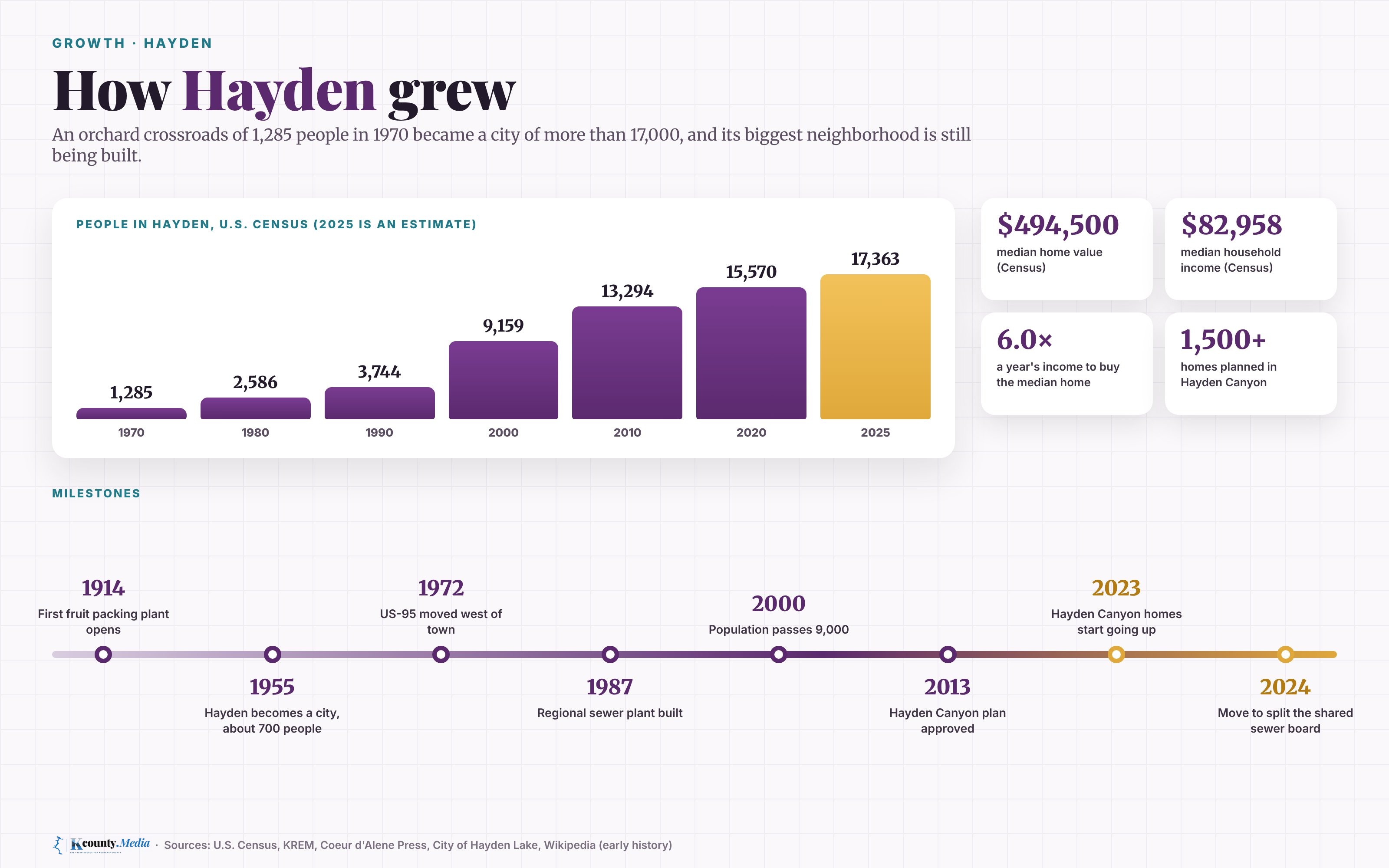
In 1970, about 1,300 people lived in Hayden. The Census Bureau now estimates 17,363. That is more than thirteen times as many people in about fifty-five years, and the biggest neighborhood in town is still being built.
This is how a crossroads north of Coeur d'Alene became a city, what's going up now, and the sewer fight that comes with it.
Orchards, then a city
Hayden started as orchard country. The first fruit packing plant opened in 1914, and by the 1920s cherry and apple orchards covered the area. Cold winters in the 1930s killed many of the trees, and many were never replanted.
As cars replaced trains, business moved from the lake shore to Government Way. A small village grew up at Honeysuckle Avenue. When a plan to join the city of Hayden Lake failed, local leaders chose to incorporate on their own. The Village of Hayden became a city in 1955, with about 700 people on 440 acres.
Government Way was the main road to Coeur d'Alene and carried Highway 95. In 1972 the state moved US-95 a little to the west to take traffic off the town's main street.
The boom years
Hayden doubled in the 1970s, from 1,285 people to 2,586, according to Census counts. It grew to 3,744 by 1990. Then it took off. In the 1990s it grew 145%, to 9,159 people in 2000. It passed 13,000 in 2010 and reached 15,570 in 2020.
Growth has slowed since, but it hasn't stopped. The Census Bureau estimates Hayden added about 1,800 people from 2020 to 2025, a gain of about 11.5%.
During the pandemic rush, a Hayden real estate agent told the Spokesman-Review that Hayden and Rathdrum were popular with buyers, partly because of the Lakeland School District. In January 2021, the county's median home price hit $415,000, up a third from a year earlier.
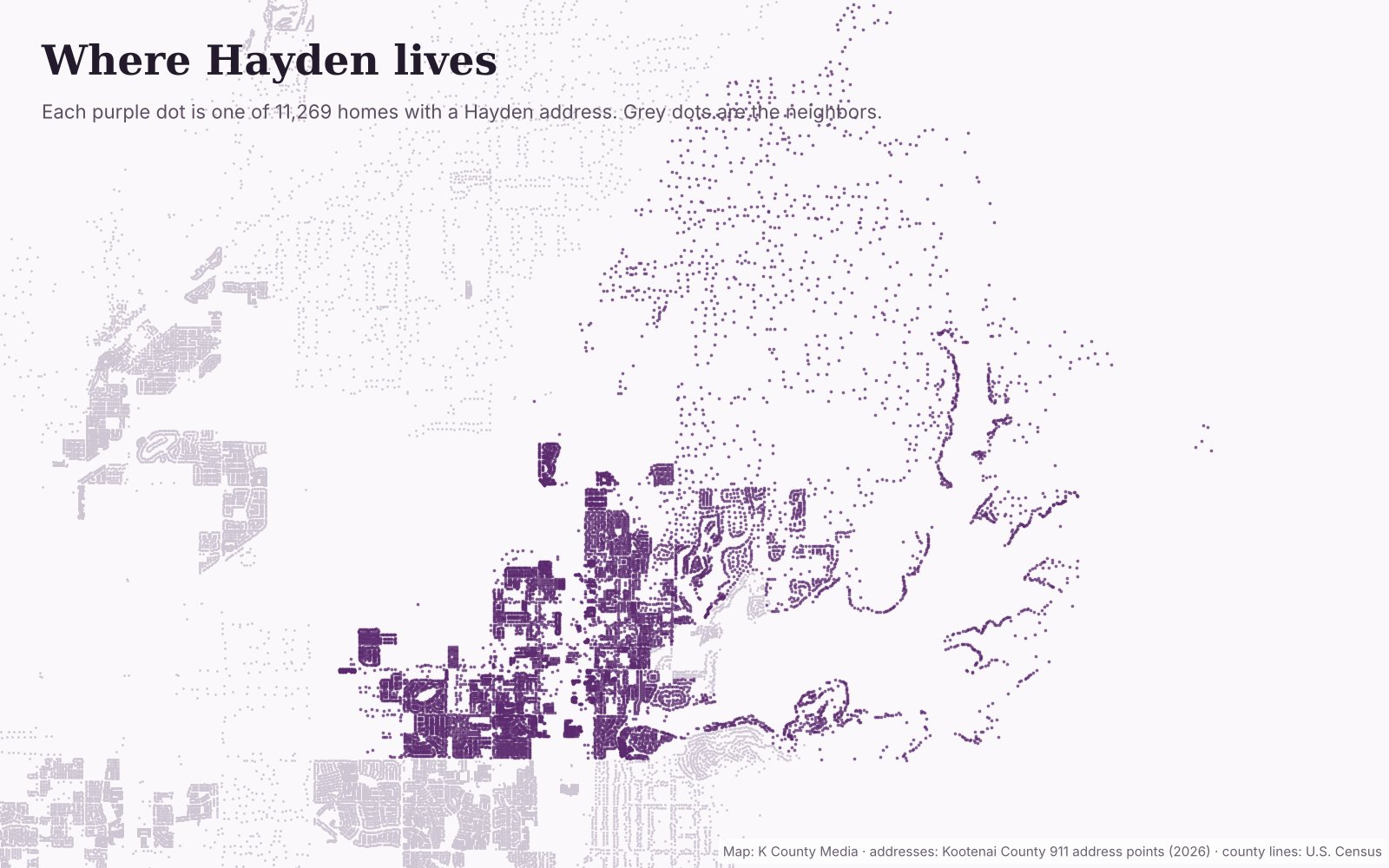
Hayden Canyon
The biggest project in Hayden's history sits south of Lancaster Road and east of Government Way. Hayden Canyon covers 610 acres. It is planned for more than 1,500 homes, at no more than 2.5 homes per acre, and about 40% of the land, roughly 247 acres, must stay open space as a condition of joining the city, KREM reported.
It took a long time to get here. The first proposal came in 2005. A try at annexing the land into the city failed in 2006, the Coeur d'Alene Press reported. The city gave its final approval about a dozen years ago. KREM, citing council minutes, put it in early 2013; the Press reported final approval in 2014. A 2016 version of the plan called for 1,820 homes, a YMCA-run community center with a pool, and a charter school.
Stafford Land Company took over the project in 2020 and sold the first phases to Lennar and SUF Holdings. In August 2021, the City Council approved the designs for a 162-lot phase on about 50 acres by a 3-1 vote. The lone no vote cited density. Lennar was advertising homes there in January 2025 starting in the high $300,000s.
What else is going up
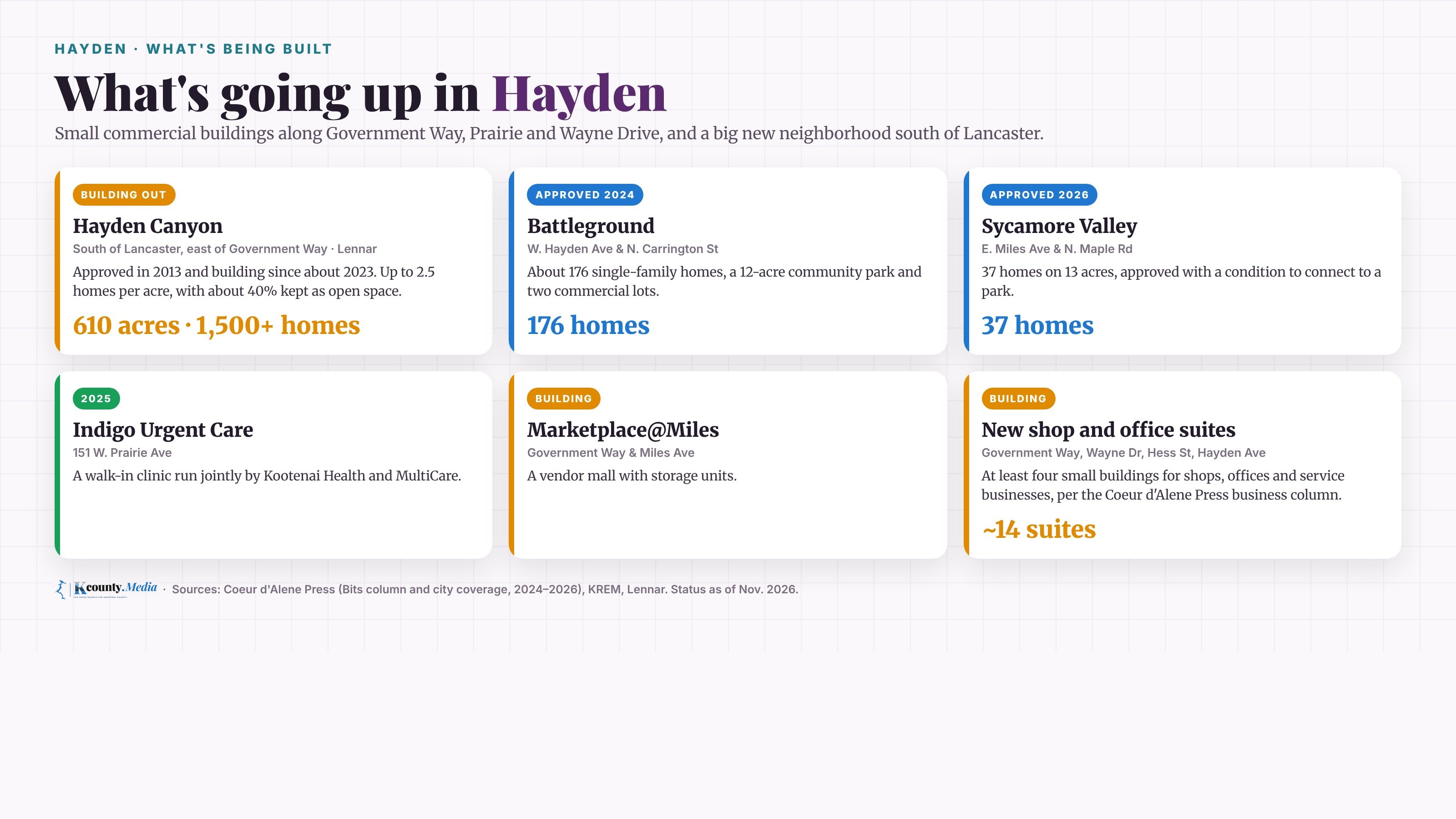
Most of the rest is smaller. In November 2024, Hayden's planning commission unanimously backed the Battleground subdivision near West Hayden Avenue and North Carrington Street: about 176 single-family homes, a 12-acre community park and two commercial lots. The Coeur d'Alene Press reported the City Council would take it up next, and that sewer work had to be finished before homes could be built.
MultiCare's Indigo Urgent Care opened a walk-in clinic at 151 W. Prairie Ave. in June 2025. And in January 2026, the council rezoned a 1.73-acre parcel south of Lancaster Road, the King Sod site, from farm land to light industrial.
The homes, and what they cost
The Census Bureau puts Hayden's median home value at $494,500 and its median household income at $82,958. That means the typical home costs about six years of the typical household's pay.
The sewer fight
Every new home in Hayden needs a sewer hookup, and that is where growth runs into its neighbor.
Since 1987, Hayden, the Hayden Lake Sewer District and Kootenai County have shared one treatment plant, run by the Hayden Area Regional Sewer Board. When it started, the lake district used about 76% of the system and the city about 23%. Today the city holds 75.2% and the lake district 23.8%, according to the district's own history.
The plant has needed big spending before. In 2014, the board broke ground on the $14.3 million first phase of a $31 million upgrade to cut the phosphorus it sends into the Spokane River.
The partners have long disagreed about growth. In 2024, Hayden and the county moved to dissolve the board so the city could take full control of the plant. Hayden's city administrator told the Press the disagreements had added cost and delay and made it harder to meet state and federal rules. At a tense meeting in January 2025, lake district representatives objected to the cost of expanding the plant, and the two sides argued over the board's land on the Rathdrum Prairie.
Mediation was set to start in December 2025, county commissioners were told. As of this story, we could not confirm how it came out.
Hayden has fought over sewer costs before. In 2007 it nearly tripled its hookup fee, from $774 to $2,280. Builders sued. After two trips to the Idaho Supreme Court, the city agreed in 2019 to pay the North Idaho Building Contractors Association $350,000 in a mediated deal.
The city is still building out its pipes. In January 2026, the city administrator listed a public-private partnership to finish a sewer main and lift station worth about $20 million, and the council hired a firm to update the hookup fee.
Where it's headed
KMPO, the region's transportation planner, projects Hayden will reach about 26,650 people by 2050, up from about 17,300 today. It expects the number of occupied homes to grow from about 6,800 to about 10,500.
The orchard crossroads has become a city of 17,000, and most of Hayden Canyon is still to come. Live here, or thinking about it? Tell us what you're seeing. Every number in this story names its source below.
Sources
- U.S. Census Bureau: City and town population estimates, 2020–2025 (Idaho)
- Census Reporter: Hayden, ID (ACS 2024 5-year)
- Wikipedia: Hayden, Idaho (Census history table, early history)
- KMPO: 2025–2050 Growth Projections (Feb. 2026)
- Spokesman-Review: Housing market frenzy occurring in North Idaho as demand rises, inventory dips to record-lows (Feb. 2021)
- KREM: Biggest housing development in Hayden underway
- Coeur d'Alene Press: Hayden Canyon's next step approved (Aug. 2021)
- Coeur d'Alene Press: Pools, school part of Hayden Canyon plan (Apr. 2016)
- Lennar: New homes unveiled in prime location in Hayden, ID (Jan. 2025)
- Coeur d'Alene Press: 176 single-family homes, community park could be coming to Hayden (Nov. 2024)
- Indigo Urgent Care: Now open in Hayden (June 2025)
- Citizen Portal: Hayden council approves rezoning of King Sod site to light industrial (Jan. 2026)
- City of Hayden Lake & Hayden Lake Sewer District: District History
- Spokane River Forum: Hayden plant aims for clean river (May 2014)
- Coeur d'Alene Press: After disagreements with Hayden Lake, Hayden and county seek to dissolve sewer board (Dec. 2024)
- Coeur d'Alene Press: 'Make us an offer': Heated exchange marks Hayden Area Regional Sewer Board meeting (Jan. 2025)
- Citizen Portal: Commissioners enter executive session after review of mediation for Hayden Area Regional Sewer Board dissolution (Dec. 2025)
- Coeur d'Alene Press: After long, expensive lawsuit, Hayden and NIBCA meet in middle (July 2019)
- Citizen Portal: City administrator summarizes 2025 accomplishments and outlines 2026 priorities (Jan. 2026)
- Citizen Portal: Hayden council approves sewer rate study, GIS update and communications contract (Jan. 2026)