
How Dalton Gardens didn't grow: the orchard town that kept its one-acre lots
Hayden grew more than thirteenfold since 1970, based on 2025 population estimates. Dalton Gardens, right next door, grew about 60%. Here's how a town of acre lots and septic tanks stayed small while the county boomed around it.
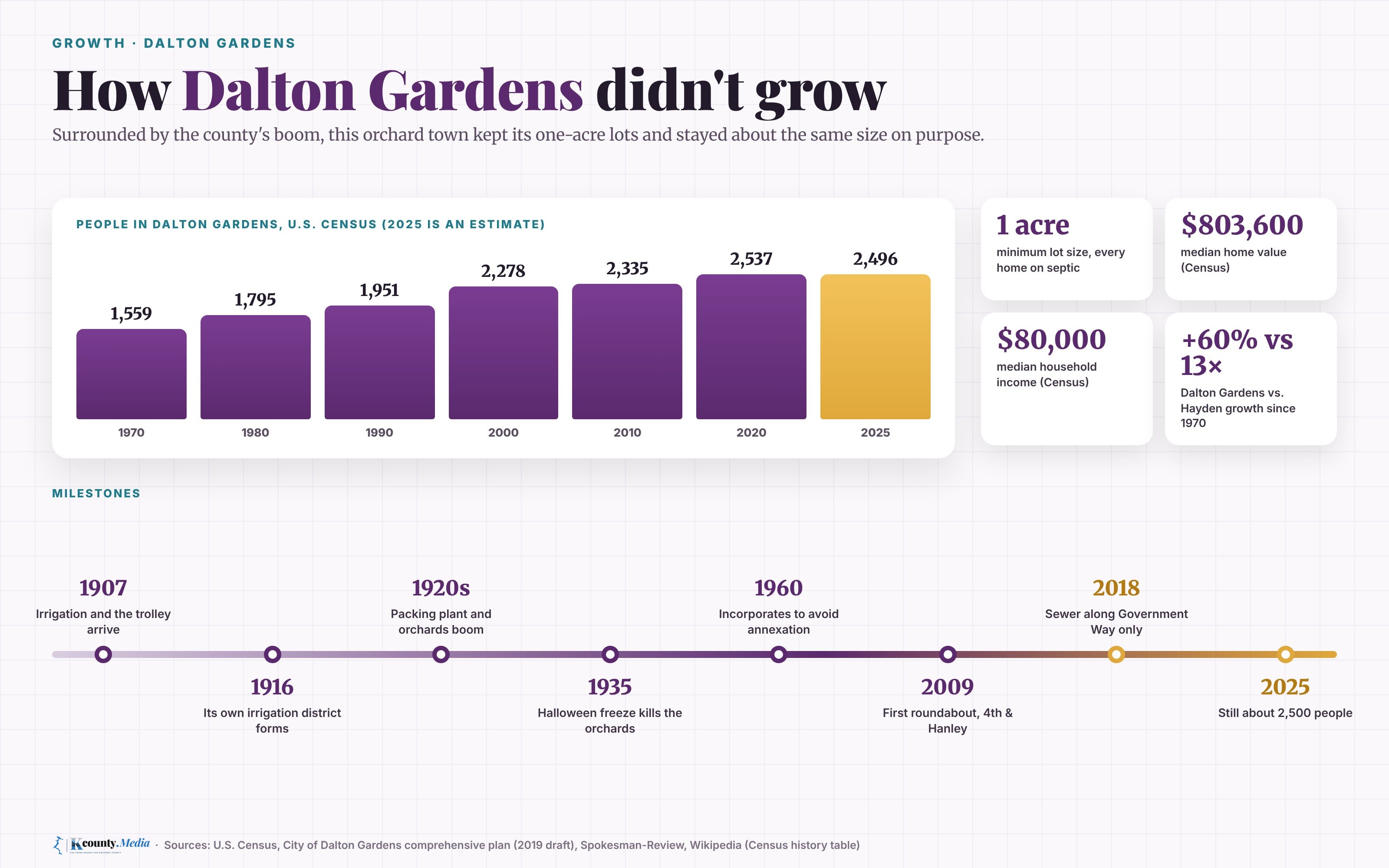
In 1970, about 1,560 people lived in Dalton Gardens. Today it's about 2,500. That's growth of about 60% in more than fifty years. Over the same stretch, Hayden, its neighbor to the north, grew from 1,285 people to about 17,300 by 2025, more than thirteen times as many. (The 2020 census counted 15,570.)
Dalton Gardens sits between Coeur d'Alene and Hayden, a short drive from Government Way. It didn't miss the boom by accident. It kept its rules on purpose.
Water, a railroad and apples
The town began as orchard country. Irrigation came in 1907, piping water from Hayden Lake to about 1,000 acres, the Spokesman-Review reported. That same year, the electric Spokane and Inland Empire Railroad put a small depot at what is now Fourth Street and Hanley Avenue, according to Kootenai County. Its trains ran between Coeur d'Alene and Hayden Lake. Dalton formed its own irrigation district in 1916.
Growers grew apples, pears, cherries and berries. In the early 1920s the Dalton Fruit Growers Association built an apple packing plant that shipped fruit to the East Coast and overseas.
Then, on Halloween 1935, a hard freeze set in. It killed about 90% of the apple trees, the Spokesman-Review reported. Most were never replanted. Passenger trains had already stopped, and freight service ended in 1937.
Becoming a city to stay a town
By the late 1950s, Coeur d'Alene was spreading north. Dalton residents feared being annexed. On March 8, 1960, Dalton incorporated, Idaho Magazine reported. The village later became the City of Dalton Gardens. Around it, Coeur d'Alene annexed the land piece by piece. Dalton stayed separate.
What stayed the same
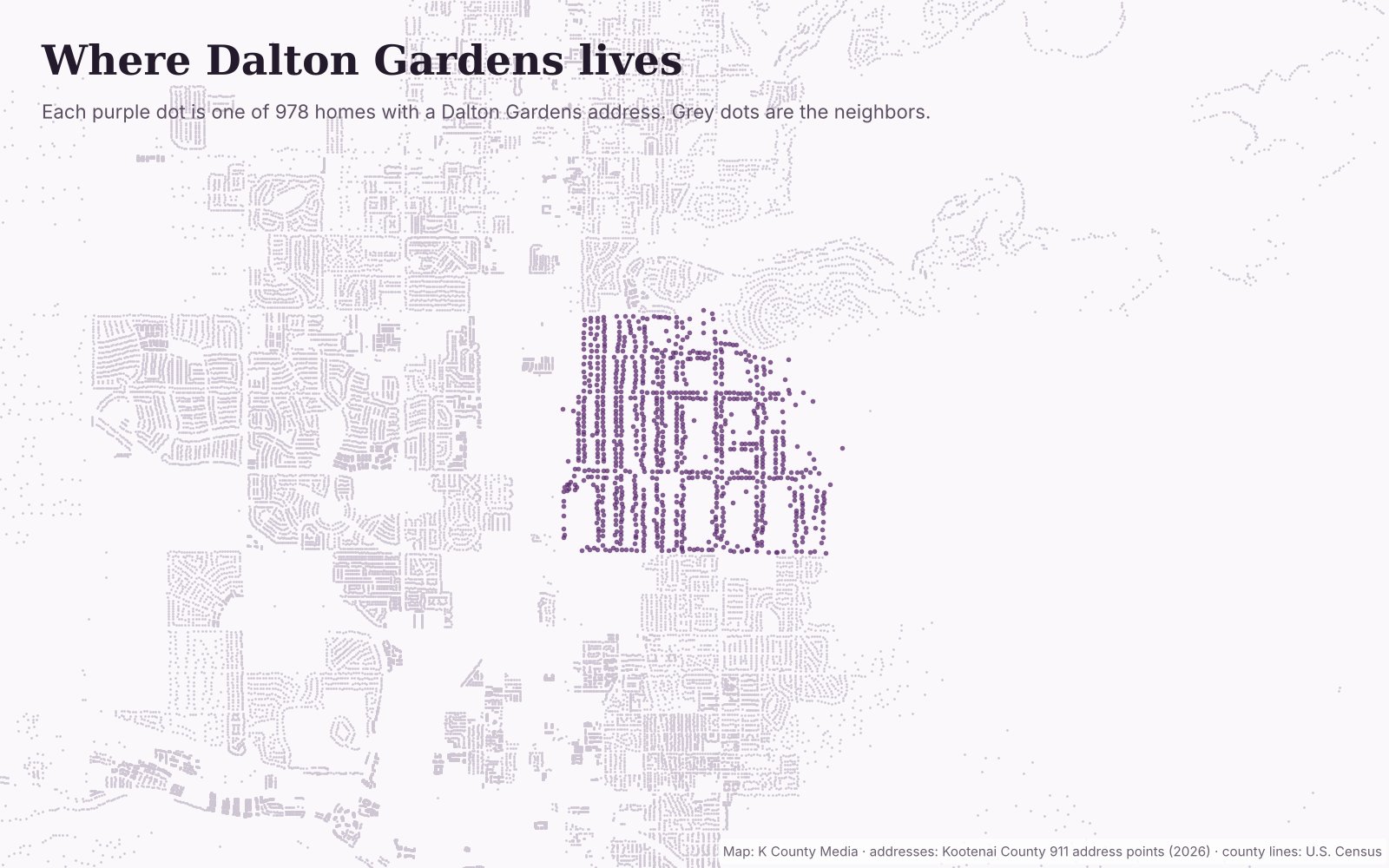
Today the town covers about 2.3 square miles. Every lot must be at least one acre, and homes run on septic systems, which have to be pumped every five years, the Coeur d'Alene Press reported. Many lots still draw irrigation water from the Dalton Irrigation District. Residents can keep horses, cattle, pigs, chickens and sheep. The speed limit is 25 mph, and fruit and vegetable stands run on the honor system.
Sewer, but only on the edge
Sewer has come to Dalton Gardens, but only to its business strip. In 2010, the city proposed extending Coeur d'Alene sewer lines down Government Way, tied to the federally funded rebuild of that road. Businesses there were held to 250 gallons of septic flow a day. At a hearing that August, 50 property owners signed a protest against the cost, the Coeur d'Alene Press reported. In January 2011, Coeur d'Alene approved a smaller improvement district for new water and sewer lines on Government Way between Dalton and Hanley avenues. In 2012, Dalton Gardens passed a sewer ordinance that limits sewer service to its commercial zone.
The fight over four lots
In 2018, a four-lot backyard subdivision on 16th Street split the town. Town rules require each lot to front a public road. The city first denied the plan, then approved it to settle a lawsuit. A residents' group warned that more lots like it could threaten the town's septic status and bring state sewer requirements, the Coeur d'Alene Press reported. In August 2018, residents started a recall drive. In 2019, voters recalled the mayor and two council members, the Inlander reported.
The same year, a draft comprehensive plan proposed mixed-use zoning along Government Way, which would allow apartments alongside businesses. The Press reported that most of the town's growth had already come along that corridor.
What it costs to live here
Big lots near a growing city don't come cheap. Census survey figures put the median home value at $803,600 and the median household income at $80,000, Data USA reports. That makes the typical home worth about ten years of the typical household's pay. In 2018, the Coeur d'Alene Press reported most homes selling in the $300,000s.
Where it's headed
KMPO, the region's transportation planner, counts about 2,490 people and 900 households in Dalton Gardens in 2025. By 2050 it expects 20 more people. Over the same years, it expects Hayden to add more than 9,300.
The orchards are mostly gone. The acre lots are not. Live here, or thinking about it? Tell us what you're seeing. Every number in this story names its source below.
Sources
- Wikipedia: Dalton Gardens, Idaho (Census history table, area)
- Wikipedia: Hayden, Idaho (Census history table)
- Spokesman-Review: Dalton retains rural flair (June 2008)
- Kootenai County: Dalton Gardens history
- Idaho Magazine: Dalton Gardens–Spotlight
- Coeur d'Alene Press: Neighborhood of the week: Dalton Gardens (July 2015)
- Coeur d'Alene Press: Dalton Gardens - always in demand (Mar. 2018)
- Coeur d'Alene Press: Dalton sewer project under fire (Sept. 2010)
- Coeur d'Alene Press: Coeur d'Alene establishes LID (Jan. 2011)
- City of Coeur d'Alene: City of Dalton Gardens sewer permits (Ordinance 224, 2012)
- Coeur d'Alene Press: Group says Dalton's future in jeopardy (July 2018)
- Coeur d'Alene Press: Dalton Gardens word wars warm up (Oct. 2018)
- Inlander: Little appoints new Dalton Gardens council member to create quorum after recall (2019)
- Coeur d'Alene Press: Dalton residents, pick a path for the future (Jan. 2019)
- Data USA: Dalton Gardens, ID (Census ACS, 2024)
- KMPO: 2025–2050 Growth Projections (Feb. 2026)
- Ballotpedia: Mayor and city council recall, Dalton Gardens, Idaho (2019)