
How Coeur d'Alene grew: from an Army fort on the lake to a city of 58,000
Coeur d'Alene is more than three times the size it was in 1970, but the towns around it are now growing faster. Here's what's rising downtown, what homes cost, and what's happening to the roads and schools.
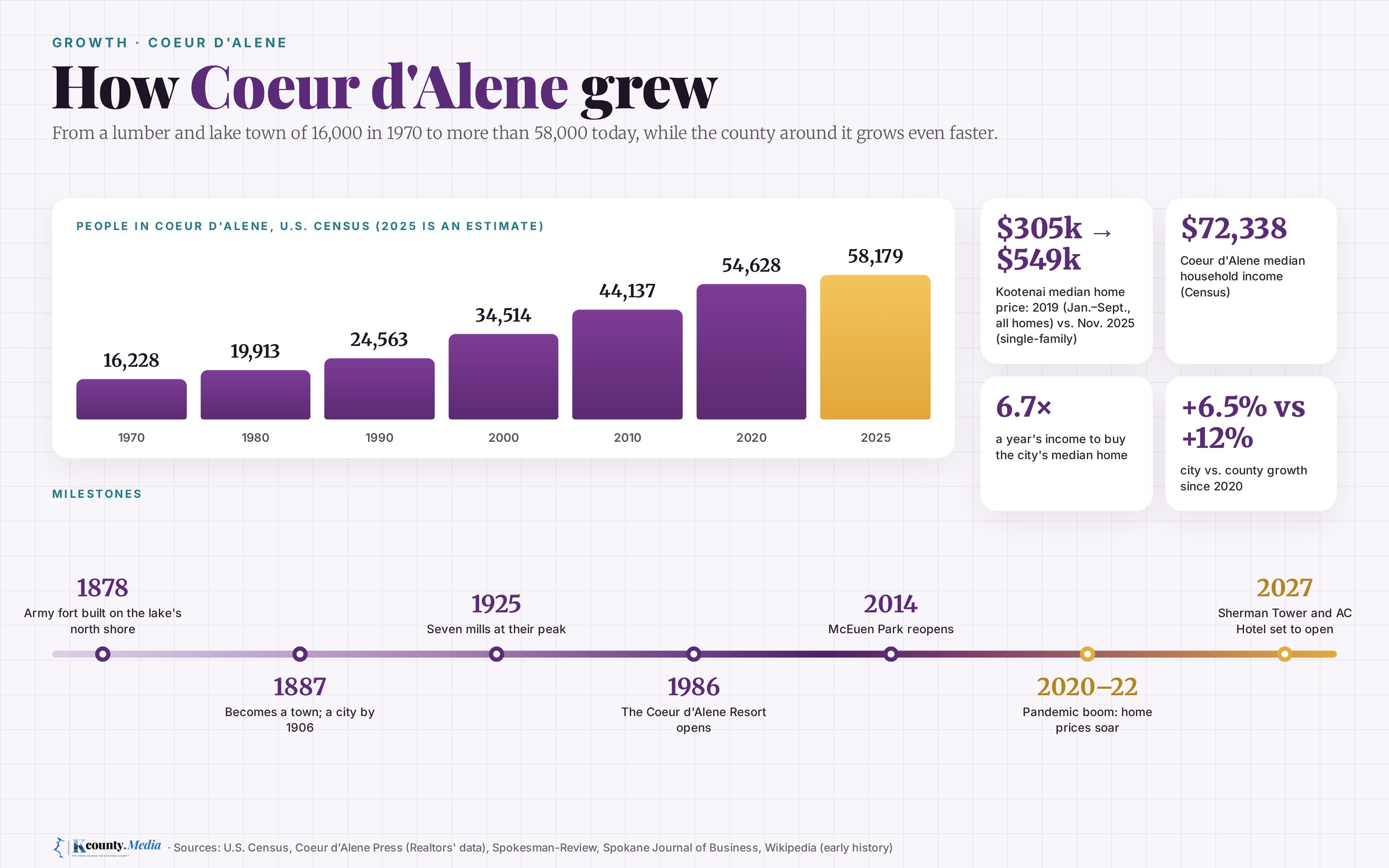
In 1970, about 16,200 people lived in Coeur d'Alene. The Census Bureau now estimates more than 58,000. The city is about three and a half times bigger than it was then, and it is still the largest city in Kootenai County.
But it is no longer the fastest-growing. Since the 2020 Census, Coeur d'Alene has grown about 6.5%. The county around it has grown about 12%. This is how the lake town grew, what's rising now, and what it costs to live here.
A fort, a mill town, a resort
Coeur d'Alene started as an Army post. In 1877, Gen. William Tecumseh Sherman picked a spot on the north shore of Lake Coeur d'Alene for a fort. The Army opened it the next spring, in 1878, and it later took his name: Fort Sherman. A town grew up around it. It was incorporated in 1887 and became a city in 1906.
Mining and timber built it. The Northern Pacific railroad reached the region in 1883, after gold and silver strikes in the mountains to the east, but a spur line connecting directly to Coeur d'Alene was not built until 1886. Timber kept the town working. By 1925 there were seven mills in the area, at the peak of a white pine boom.
For most of the next half-century, growth was slow and steady. Then the town turned toward the lake. The Coeur d'Alene Resort opened in the spring of 1986, an 18-story, $60 million hotel with a floating boardwalk that drew national attention.
The numbers
Census counts show the city growing every decade since 1970: 16,228 that year, 19,913 in 1980 and 24,563 in 1990. The biggest jump came in the 1990s, when the city grew about 40% to 34,514. It reached 44,137 in 2010 and 54,628 in 2020.
The Census Bureau's latest estimate puts Coeur d'Alene at 58,179 as of July 2025.
What homes cost
Home prices have climbed much faster than paychecks. In the first nine months of 2019, the median home in Kootenai County sold for $305,000, the Coeur d'Alene Press reported from Multiple Listing Network data. By November 2025, the median single-family home sold for $549,000, according to the Coeur d'Alene Regional Realtors Association.
Inside the city, the Census Bureau's survey puts the median value of an owner-occupied home at $483,500 and the median household income at $72,338. That means the typical home is worth about 6.7 years of the typical household's pay. Coeur d'Alene's household income is lower than the county's as a whole.
What's rising now
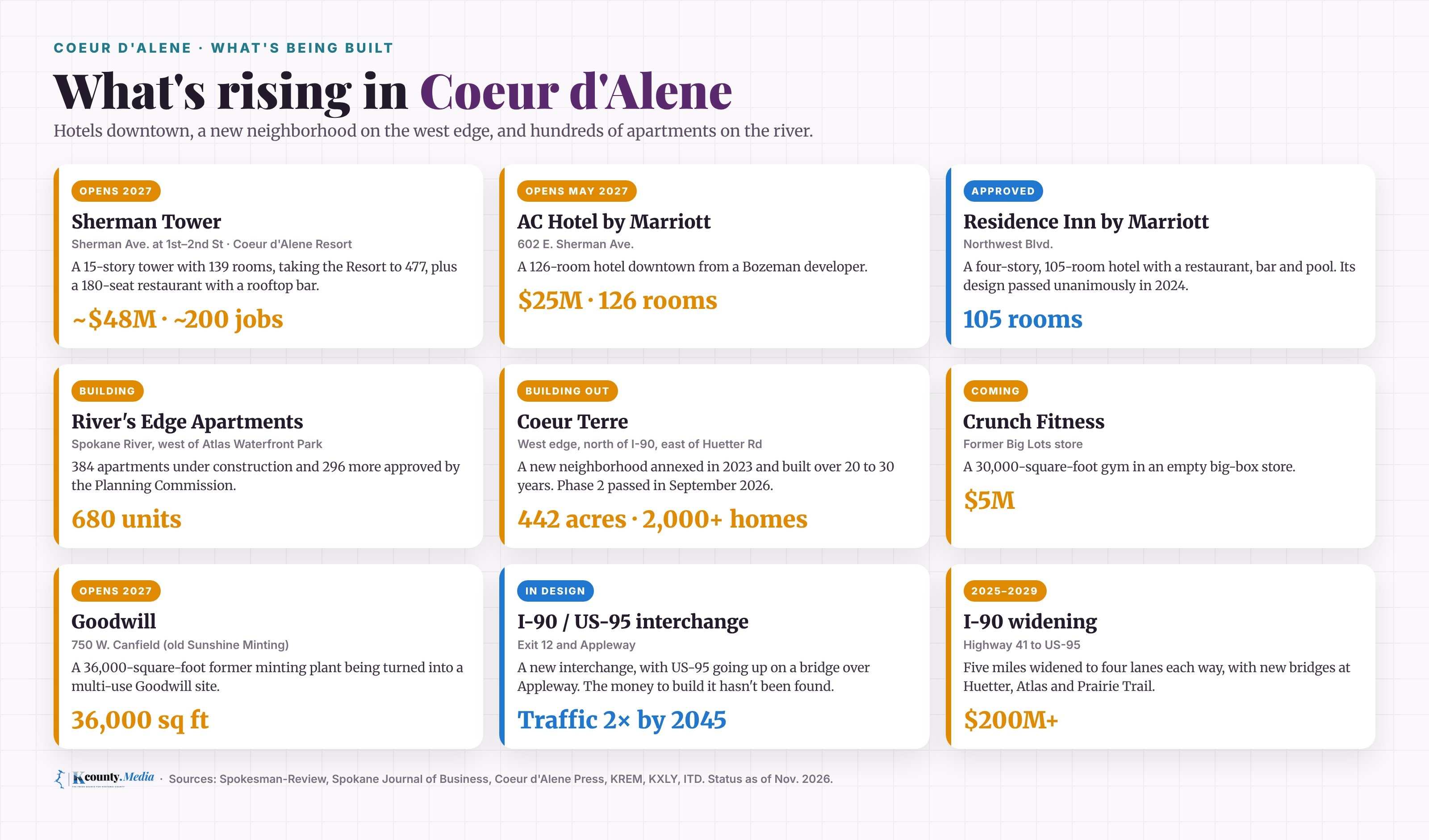
Downtown, two hotels are going up at once. The Coeur d'Alene Resort is building the 15-story Sherman Tower on the north side of Sherman Avenue. It adds 139 rooms, taking the resort to 477. The Spokane Journal of Business put the cost at $48 million. The Spokesman-Review reported it will need about 200 more workers and will have a 180-seat restaurant and a rooftop bar. It is expected to open in 2027.
About a half-mile east, a Bozeman developer is building a 126-room AC Hotel by Marriott at 602 E. Sherman Ave. It's a $25 million project, expected to open in May 2027, the Journal reported in March.
On the Spokane River west of Atlas Waterfront Park, River's Edge Apartments has 384 units under construction. The city Planning Commission voted 6-0 to approve 296 more, KREM reported, which would bring the project to 680 homes. The City Council still had to weigh in.
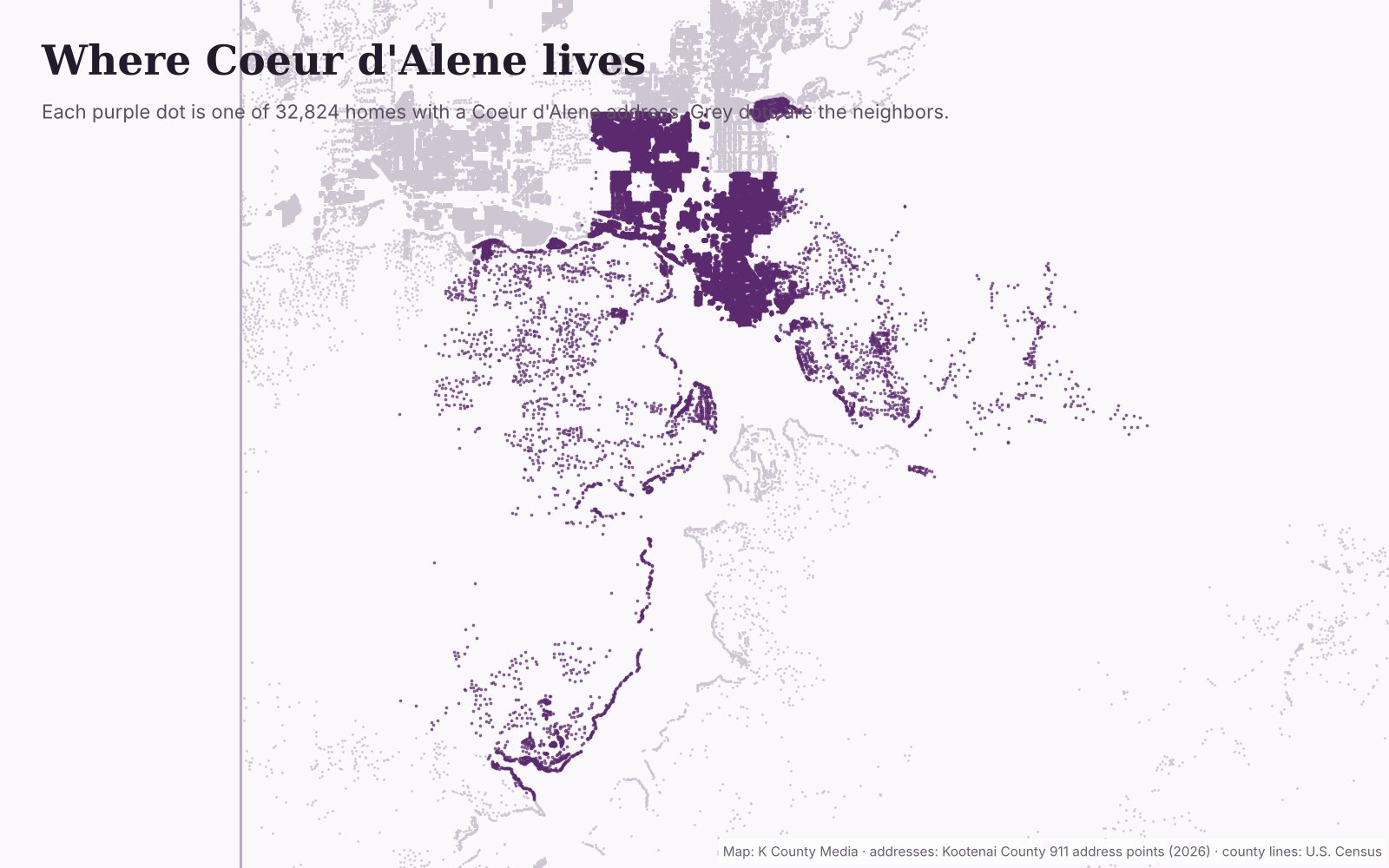
The biggest change is on the west edge of town. In March 2023, the City Council voted 4-2 to annex Coeur Terre, about 440 acres north of I-90 and east of Huetter Road. A development agreement caps it at 2,800 homes, the Spokesman-Review reported. An engineer on the project called it a slow build, comparing it to Coeur d'Alene Place, which has taken about 30 years to fill in. The land sits between Coeur d'Alene and Post Falls.
The roads
Interstate 90 is being widened for about five miles, from Highway 41 in Post Falls to US-95 in Coeur d'Alene. The work started in August 2025 and adds lanes until there are four each way, with new, wider bridges at Huetter Road, Atlas Road and the Prairie Trail. It's due to finish in 2029. The Spokane Journal of Business put the total cost at about $200 million.
At the east end of that stretch, the state is planning a new I-90 and US-95 interchange. The Idaho Transportation Department says traffic there is expected to roughly double by 2045. In 2025, the state's transportation board picked the interchange for new state road money and said construction could begin as early as 2027. ITD showed a revised design at an open house last November.
North of the interstate, the drive is projected to get much slower. An ITD study of the Rathdrum Prairie found the evening trip north on US-95 from Lancaster Road to Emma Avenue took about 16 minutes in 2023. If nothing new is built, it projected that same drive would take about 46 minutes by 2045.
The schools
The schools have faced their own money squeeze. In April 2024, facing a budget gap of about $6 million, Coeur d'Alene school trustees voted to close Borah Elementary and turn it into an early learning center, Spokane Public Radio reported. The closure was expected to save about $1 million.
Where it's headed
The Kootenai Metropolitan Planning Organization, the region's transportation planner, expects Coeur d'Alene to keep growing, to about 86,600 people by 2050. But Post Falls is growing faster. By KMPO's count, Post Falls passes Coeur d'Alene in population around 2045.
The fort town by the lake is still the county's biggest city, for now. Live here, or thinking about it? Tell us what you're seeing. Every number in this story names its source below.
Sources
- U.S. Census Bureau: City and town population estimates, 2020–2025 (Vintage 2025)
- Wikipedia: Coeur d'Alene, Idaho (Census history table, early history)
- U.S. Census Bureau American Community Survey 2020–2024, via Census Reporter: median household income and home value, Coeur d'Alene and Kootenai County
- Coeur d'Alene Press: Real estate prices going up, up, up (Oct. 2019)
- Coeur d'Alene Press: Kootenai median home price rises (Dec. 2025)
- Spokane Journal of Business: Two hotel projects rise in downtown Cd'A (Mar. 2026)
- Spokesman-Review: Coeur d'Alene Resort adding another tower as part of its biggest upgrade ever (Mar. 2025)
- KREM: River's Edge Apartments wins approval to build new units in Coeur d'Alene
- Spokesman-Review: Coeur d'Alene greenlights massive 2,800-home development (Mar. 2023)
- ITD: Construction begins to widen I-90 between Post Falls and Coeur d'Alene (Aug. 2025)
- Spokane Journal of Business: I-90 widening is under way in Kootenai County (Mar. 2026)
- ITD: I-90 and US-95 Interchange identified for further funding (2025)
- ITD: ITD to share revised design for I-90/US-95 interchange at open house (Nov. 2025)
- ITD: Huetter Corridor to Rathdrum study, Purpose and Need memo (May 2024)
- Spokane Public Radio: Coeur d'Alene school trustees approve budget cutting measures (Apr. 2024)
- KMPO: 2025–2050 Growth Projections (Feb. 2026)
- Idaho State Historical Society: Fort Sherman, Reference Series No. 355 (1979)